 HIPAA Compliant
 ISO 27001 Certified

National Alzheimer's Disease Awareness Month 2026: what has changed, and how can families help research?
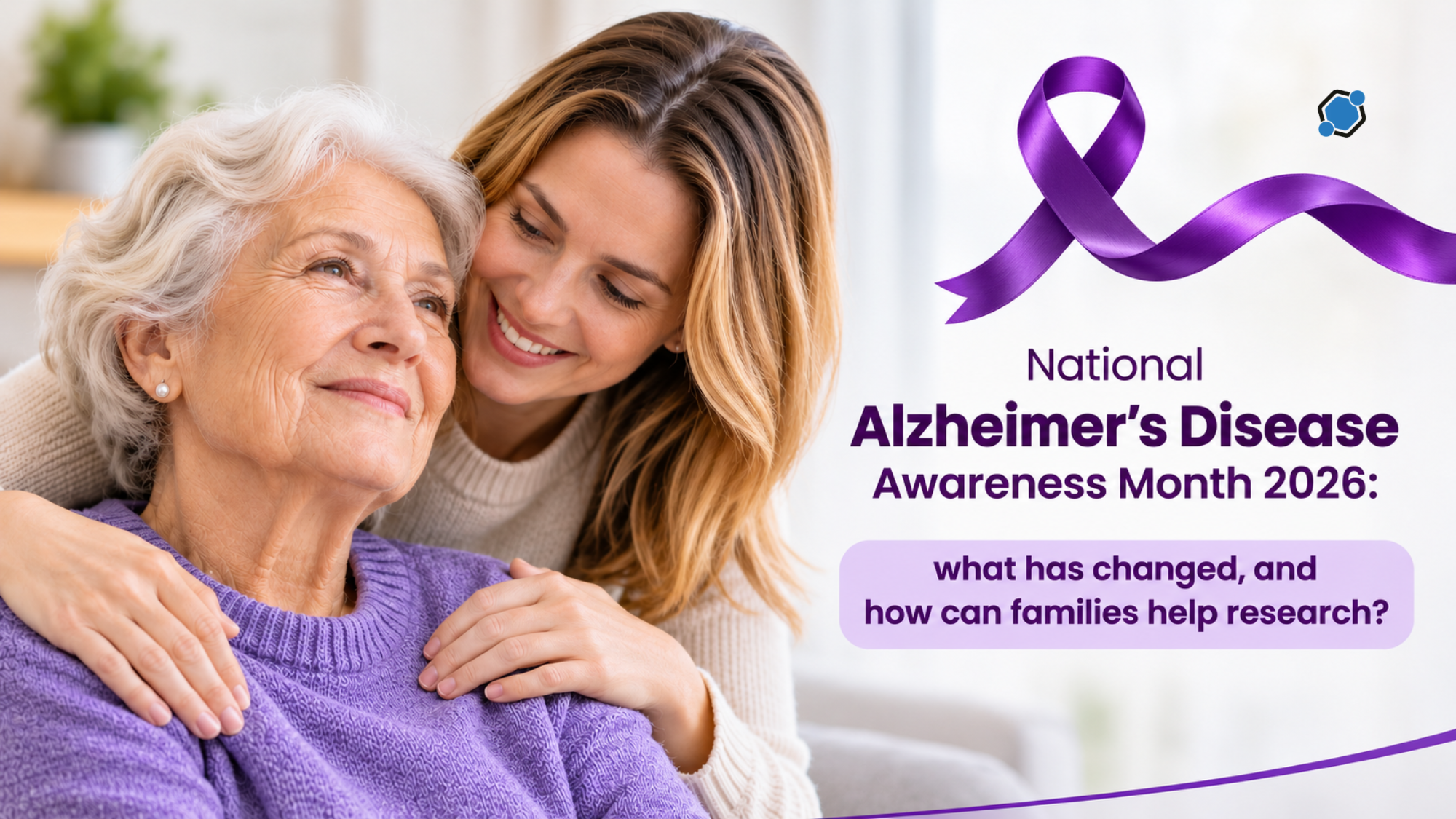
National Alzheimer's Disease Awareness Month is observed every November in the United States. In 2026, it runs from Sunday, November 1, through Monday, November 30. The month draws attention to a disease that affects about 1 in 9 Americans age 65 and older, more than seven million people, and to the family members and friends who provide most of their care.
November is also National Family Caregivers Month, which makes the two observances a natural pair. Alzheimer's research depends on these families as much as it depends on patients.
What is National Alzheimer's Disease Awareness Month?
The observance began in 1983, when President Ronald Reagan proclaimed November as National Alzheimer's Disease Month at the request of Congress. Eleven years later, Reagan publicly shared his own Alzheimer's diagnosis in a handwritten letter, which brought national attention to the disease.
Recent administrations and many states continue to mark the month. The purpose has stayed consistent: improve public understanding, recognize people living with the disease, support caregivers, and encourage research.
The 2026 theme for National Family Caregivers Month, set by a national caregiver organization, is "Care Connects Us." The theme fits Alzheimer's closely, because dementia care in the United States is overwhelmingly family care.
Three Alzheimer's observances appear on the calendar each year, and each has a different focus:
- June is Alzheimer's and Brain Awareness Month, a U.S. campaign that centers on brain health.
- September is World Alzheimer's Month, a global campaign that covers all forms of dementia.
- November is National Alzheimer's Disease Awareness Month, the U.S. observance that focuses on the disease itself and on the families affected by it.
Alzheimer's vs. dementia: what is the difference?
Dementia is not a single disease. It is a syndrome, meaning a group of symptoms such as memory loss, language problems, confusion, and poor judgment that are severe enough to interfere with daily life. Alzheimer's disease is the most common cause of dementia and accounts for the majority of cases.
Other causes include vascular disease (reduced blood flow to the brain) and Lewy body disease. Many older adults with dementia have more than one type of brain change at the same time, which is known as mixed dementia.
What happens in the brain
Alzheimer's involves two abnormal proteins. Beta-amyloid forms sticky clumps called plaques that build up between nerve cells. Tau forms twisted strands called tangles inside nerve cells. Over time, affected nerve cells stop working and die, and the brain shrinks.
These changes can begin as many as two decades before the first symptoms appear. Researchers now describe Alzheimer's as a continuum: a symptom-free (preclinical) stage, then mild cognitive impairment (measurable memory or thinking problems while a person can still manage daily life), and then mild, moderate, and severe dementia.
Early warning signs vs. normal aging
Some changes in memory are a normal part of aging. The difference lies in how much the change disrupts everyday life:
- Asking the same question repeatedly is a possible warning sign. Occasionally forgetting a name and recalling it later is typical of aging.
- Trouble following a familiar recipe or keeping track of monthly bills is a possible warning sign. Making an occasional error with a bill is typical.
- Getting lost on the way to a familiar place is a possible warning sign. Needing help now and then with a new device setting is typical.
- Losing track of seasons or the passage of time is a possible warning sign. Briefly forgetting the day of the week and figuring it out later is typical.
Other conditions can cause similar symptoms, including depression, sleep apnea, thyroid problems, vitamin deficiencies, and medication side effects. Several of these are treatable, which is one reason early diagnosis matters. Anyone noticing persistent changes should talk with a doctor.
Who is at higher risk?
Age is the strongest known risk factor. Family history and genetics also play a role. A gene variant called APOE4 raises risk, and carrying two copies raises it further, but it does not mean a person will develop the disease. Almost two-thirds of Americans with Alzheimer's are women, and older Black Americans are about twice as likely as older White Americans to have Alzheimer's or another dementia.
A 2024 international expert commission identified 14 risk factors that can be changed, including high blood pressure, hearing loss, physical inactivity, smoking, diabetes, high LDL cholesterol, untreated vision loss, and social isolation. The commission estimated that addressing them could delay or prevent a substantial share of dementia cases worldwide. This is a population-level estimate, not a guarantee for any individual, and no approach has yet been proven to prevent Alzheimer's.
What has changed in Alzheimer's diagnosis and treatment?
The past few years have brought major changes to how Alzheimer's is diagnosed and treated.
Blood tests for people with symptoms
For years, confirming the amyloid plaques of Alzheimer's required a brain PET scan or a spinal tap. In May 2025, the U.S. Food and Drug Administration (FDA) cleared the first blood test to help diagnose Alzheimer's. By August 2026, four blood tests had been cleared. These tests measure proteins such as p-tau217 that act as signals of disease in the body, known as biomarkers.
The cleared tests are intended for adults who already have memory or thinking symptoms. They are not screening tests for people without symptoms, and a result is not a diagnosis on its own. A clinician interprets it alongside a full evaluation, because false positives and false negatives can occur.
Treatments that slow early disease
Since 2023, the FDA has approved two antibody medicines that clear amyloid from the brain. Both are approved only for people in the early symptomatic stage (mild cognitive impairment or mild dementia) with confirmed amyloid. In clinical trials, they modestly slowed decline over about 18 months. They do not stop or reverse the disease, and they are not used for moderate or severe dementia. In 2026, an under-the-skin injection of one of these medicines became available for starting treatment at home.
Both medicines carry a boxed warning, the FDA's strongest safety warning, for amyloid-related imaging abnormalities (ARIA). ARIA appears on MRI scans as temporary swelling in areas of the brain or as tiny spots of bleeding. Most cases cause no symptoms and are found through scheduled scans, but serious cases have occurred. The risk is higher in people who carry two copies of APOE4.
There is still no cure for Alzheimer's disease. Rigorous trials also show which ideas do not hold up: in 2025, a large trial of a widely used diabetes and weight-management medicine found that it did not slow early Alzheimer's.
Why caregivers matter in Alzheimer's care and research
Millions of family members and friends provide unpaid care for people living with Alzheimer's or another dementia. Together, they contribute billions of hours of care each year, work valued in the hundreds of billions of dollars.
The study partner role
Most Alzheimer's clinical trials require each participant to enroll with a study partner: someone who knows the participant well, usually a spouse, adult child, or close friend. The study partner may attend visits or join by phone and reports on changes in memory, mood, and daily functioning. Many families find it helpful to understand who handles what during a trial before agreeing to take part.
Before agreeing to serve as a study partner, a caregiver can ask the study team several practical questions:
- How many visits are required, how long does each one last, and can any take place by phone or video?
- What will the study partner be asked to report, and how often?
- Are travel costs or other expenses covered?
- What happens if the study partner can no longer continue?
Consent and decision-making
Many people with early Alzheimer's can still make their own decisions about research. When a person can no longer do so, a legally authorized representative, often a health care proxy, may give permission on their behalf, depending on state law. The study partner and the legally authorized representative are often the same person, but the roles are different: one reports on daily life, while the other gives legal permission.
Informed consent is an ongoing conversation rather than a single signature. Every study is reviewed by an independent ethics committee called an institutional review board (IRB), and participants can leave a study at any time, for any reason.
Why Alzheimer's research needs volunteers, including people without symptoms
Because brain changes begin years before memory problems, some of the most important Alzheimer's research now involves people who feel completely healthy. Prevention trials test whether treating amyloid before symptoms appear can delay or prevent decline. Their results are not expected until later this decade, so whether this approach works remains unknown.
These studies need very large numbers of volunteers. In one recent prevention trial, more than 9 in 10 people who went through screening did not qualify, most often because of a blood test result. Being screened out is a normal part of research, not a reflection on the volunteer.
Research also needs to reflect the people most affected by the disease. Older Black and Hispanic Americans have higher rates of dementia, yet they remain sharply underrepresented in Alzheimer's trials. Strict eligibility criteria, travel demands, and limited outreach to community clinics all contribute to that gap, and closing it is a shared responsibility across the research system.
Studies also seek people with a family history of the disease and caregivers. Some are observational studies that track memory and health over time without testing a treatment, and some can be completed online. Older adults interested in contributing can learn more about how older adults can join research.
Frequently asked questions about Alzheimer's and research
When is National Alzheimer's Disease Awareness Month?
It takes place every November in the United States. In 2026, it runs from Sunday, November 1, through Monday, November 30, alongside National Family Caregivers Month.
Can a blood test show whether someone will get Alzheimer's?
The FDA-cleared blood tests are designed for adults who already have memory or thinking symptoms. They help a clinician assess whether Alzheimer's brain changes are likely present. They are not intended to predict the disease in people without symptoms.
Can a person with dementia take part in a clinical trial?
Many people with dementia can take part, depending on the study. If a person can no longer make research decisions, a legally authorized representative may give permission, and the person's wishes are still respected throughout the study.
Can caregivers join Alzheimer's studies themselves?
Caregivers can take part as study partners, and many studies focus specifically on caregivers, testing ways to reduce stress and improve support at home.
Turning awareness into action this November
Progress against Alzheimer's depends on people with memory changes who take part in research, on healthy volunteers who join prevention studies, and on families who serve as study partners while caring for someone they love.
DecenTrialz is a clinical trial recruitment and pre-screening platform that helps connect people with relevant clinical studies. A person shares some information about their health, is matched with studies that may fit, and a registered nurse reviews that information before a referral goes to the research site team. The research site team makes the final eligibility decision and handles informed consent, the study walk-through, and enrollment. DecenTrialz does not provide medical care or guarantee enrollment in any study.
Anyone with questions about memory changes, diagnosis, or treatment should speak with a doctor first. Families interested in Alzheimer's research can explore study opportunities at decentrialz.com.
Was this article helpful?

Similar Blogs
Pancreatic Cancer Awareness Month 2026: what are the warning signs, and how is research changing care?
Pancreatic cancer accounts for a small share of cancer diagnoses in the United States but ...
 Mahesh Upadrista

Lung Cancer Awareness Month 2026: what are the risks, and who should get screened?
Lung cancer causes more deaths in the United States than any other cancer, yet the one scr...
Vamshi Kantoju
National Diabetes Month 2026: What is diabetes, and why does early action matter?
National Diabetes Month runs from Sunday, November 1, to Monday, November 30, 2026, and fo...
 Anish Teepireddy
Stay Informed. Stay Connected.
Get updates on verified clinical trials, emerging treatments, and research breakthroughs directly in your inbox. No spam, just science that matters.
