 HIPAA Compliant
 ISO 27001 Certified
World Alzheimer's Day 2026: What Is It, and Why Does Early Diagnosis Matter?
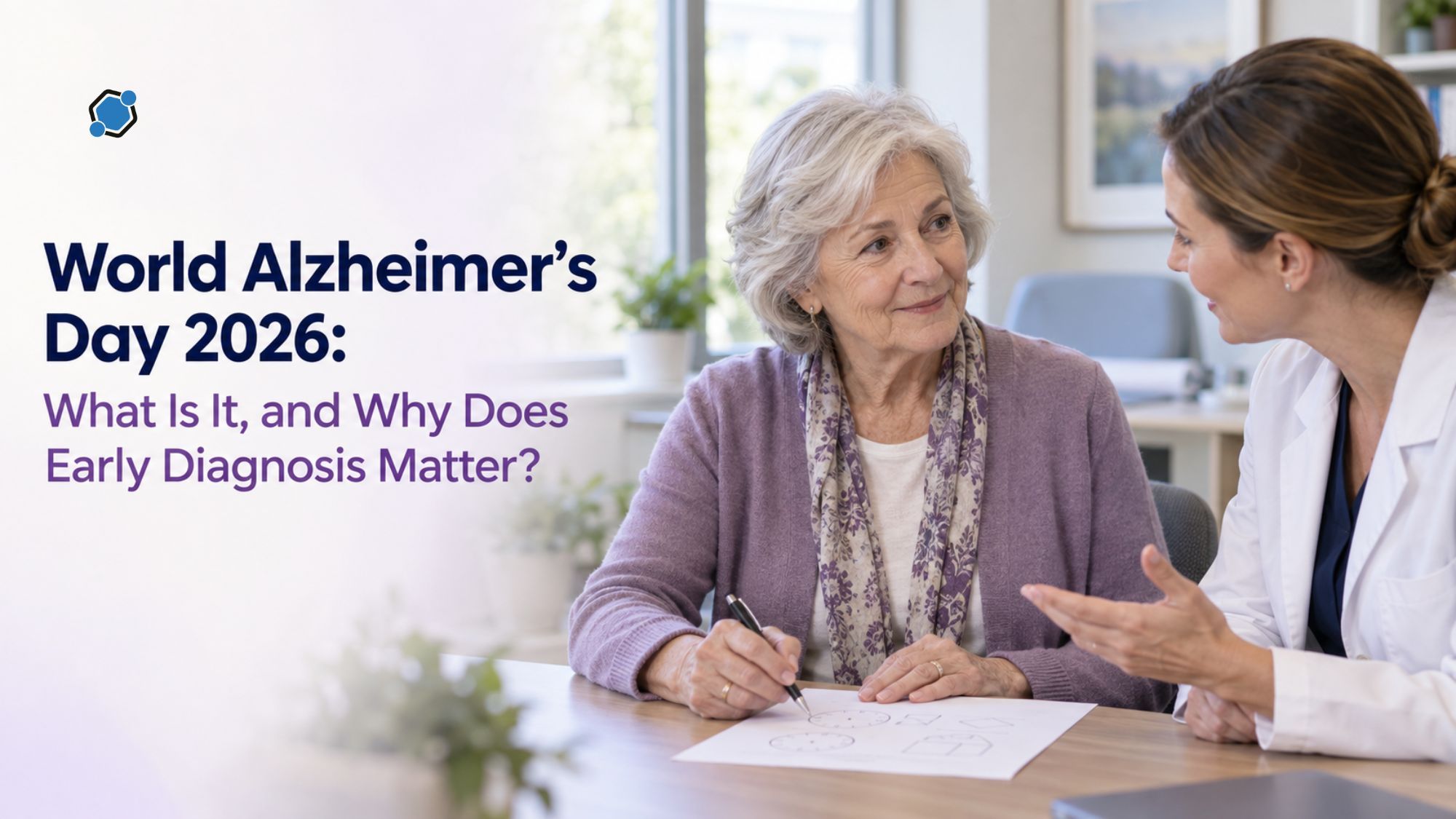
On September 21, 1994, Alzheimer's Disease International held the first World Alzheimer's Day to mark the organization's tenth anniversary and to give families, physicians, and researchers a single day each year to focus public attention on Alzheimer's disease. The date has been observed every September 21 since. In 2026 it falls on a Monday and anchors World Alzheimer's Month, a September-long global campaign coordinated by Alzheimer's Disease International.
This year's theme, "The Earlier You Know, The More You Can Do: A Dementia Diagnosis Matters," addresses a specific challenge. Most people who are living with dementia worldwide have never received a formal diagnosis, and public understanding of Alzheimer's is often incomplete or inaccurate. Early diagnosis is not simply a label. It opens access to treatment options, planning time, support services, and research opportunities that become harder or impossible to use once the disease progresses.
What Is World Alzheimer's Day, and When Is It Observed?
World Alzheimer's Day is observed on September 21 each year. It was established by Alzheimer's Disease International in 1994 and expanded in 2012 to become the focal point of World Alzheimer's Month, held throughout September. The observance is recognized by the World Health Organization and marked by national Alzheimer associations, hospitals, universities, and community groups in more than one hundred countries.
The color associated with Alzheimer's and dementia awareness is purple. On September 21, memorials, landmarks, and clothing items are often lit or worn in purple to signal support for people living with the disease and for the caregivers, researchers, and clinicians who support them.
The day serves three practical purposes. It reduces stigma by encouraging open conversation. It shares accurate information to counter widespread misconceptions about aging and memory. And it draws attention to the research effort that will shape care for future generations. For a fuller look at the September-long campaign and its ties to research, see the World Alzheimer's Month 2026 overview.
Alzheimer's vs. Dementia: What Is the Difference, and What Are the Warning Signs?
One of the most persistent misconceptions is that Alzheimer's and dementia are the same thing. They are not. Dementia is a broad term for a group of symptoms, including decline in memory, thinking, reasoning, and daily function, that are severe enough to interfere with independent living. Alzheimer's disease is a specific brain disease and the most common cause of dementia. Other causes include vascular dementia, Lewy body dementia, and frontotemporal dementia.
Alzheimer's involves gradual damage to nerve cells in the brain, associated with the buildup of two abnormal proteins called amyloid and tau. Changes in the brain can begin a decade or more before any noticeable symptoms appear, which is why researchers and physicians place so much weight on early recognition.
The Alzheimer's Association describes ten warning signs that distinguish Alzheimer's-related changes from ordinary aging:
- Memory loss that disrupts daily life
- Difficulty planning or solving problems
- Trouble completing familiar tasks at home or work
- Confusion with time or place
- Trouble understanding visual images and spatial relationships
- New difficulty with words in speaking or writing
- Misplacing items and losing the ability to retrace steps
- Decreased or poor judgment
- Withdrawal from work or social activities
- Changes in mood or personality
Occasionally forgetting a name and recalling it later is a common part of normal aging. Repeatedly asking the same question, becoming lost in a familiar neighborhood, or struggling with tasks that were once routine is not. Because Alzheimer's risk rises sharply with age, adults over sixty-five and their families benefit from knowing these signs. Older adults who want to understand how healthy aging and research participation intersect can read Healthy Aging Month 2026.
Why Early Diagnosis Matters More Than Ever
The 2026 World Alzheimer's Day theme centers on early diagnosis for a reason. The tools available to identify Alzheimer's have changed significantly in the last two years, and the treatments that follow a diagnosis are most useful when the disease is caught early.
In May 2025, the U.S. Food and Drug Administration cleared the first blood-based test to aid in Alzheimer's diagnosis, for use in adults with symptoms of cognitive decline seen in specialty care. The test measures a ratio of two proteins in the blood that correlate with the presence of amyloid in the brain. It is not a stand-alone diagnosis, and it is not intended for people without symptoms. It is one part of a broader evaluation that also includes cognitive testing, medical history, brain imaging when needed, and sometimes cerebrospinal fluid testing. Its significance is practical. Blood-based testing may make the evaluation process more accessible than approaches that require specialized imaging or a lumbar puncture.
An earlier diagnosis also expands the options available to the person and family. Anti-amyloid therapies approved in recent years are indicated for early symptomatic disease, not for advanced stages. Non-drug interventions have a longer runway to work when started early. Family members have more time to plan for care, finances, and living arrangements. And people who wish to consider clinical trial participation are more likely to be eligible when the disease is at an earlier stage. What participation actually involves at home is described in home nursing visits in clinical trials, which many modern studies now include.
Progress in Treatment, Prevention, and Everyday Brain Health
Alzheimer's care has entered a period of meaningful change. Two anti-amyloid therapies delivered by infusion have received full U.S. Food and Drug Administration approval for people with early symptomatic Alzheimer's. These medications are the first approved to target the underlying disease biology rather than only easing symptoms. Their effects on decline are modest, and they carry real risks that require magnetic resonance imaging monitoring and confirmation of amyloid pathology before treatment can begin. They are prescribed and managed by specialist teams.
Older classes of medication, including cholinesterase inhibitors and memantine, continue to be used to ease symptoms across different stages of the disease. These do not slow the underlying process but can help with day-to-day cognition and function.
Prevention research has produced some of the most encouraging findings. In July 2025, results from a large multi-site U.S. lifestyle study showed that a structured program combining physical activity, nutrition, cognitive engagement, and monitoring of blood pressure, cholesterol, and blood sugar can support cognitive function in older adults at risk for decline. Independent expert commissions have also identified a set of modifiable factors, spanning cardiovascular health, hearing, physical activity, education, diet, sleep, and social connection, that may reduce or delay a meaningful portion of dementia cases when addressed across the life course. None of this eliminates Alzheimer's risk, but the direction of the evidence supports paying attention to brain health long before symptoms appear. A broader view of brain health and everyday prevention is available in the World Brain Day 2026 overview.
How Clinical Research Is Changing What Comes Next
Alzheimer's Disease International has announced that the 2026 World Alzheimer Report will focus on clinical trials. That focus reflects both the pace of research and the challenges recruitment faces. Alzheimer's studies span three broad categories: prevention studies in people who are cognitively healthy but at risk, disease-modifying studies in people with early symptoms, and studies focused on symptoms and behavioral changes at later stages.
Two persistent challenges shape the trial landscape. First, participants in Alzheimer's studies have historically not reflected the populations most affected by the disease. Older Black and Hispanic adults face higher rates of Alzheimer's than older white adults, yet they remain underrepresented in the studies that shape treatment decisions. Second, most Alzheimer's studies require a study partner, someone who knows the participant well and can accompany them to visits and report on daily function. This requirement supports participant safety and data quality, but it can be a barrier for people who live alone or whose closest family members live far away.
For families who want to explore trial participation, connecting the person with the right study is often the hardest step. DecenTrialz is a platform that supports this early stage: a person shares some information about their health and situation, an algorithm identifies studies that may fit, and a registered nurse pre-screens by phone or video. When there is a potential match, the person is referred to the research site team. The research site team, not DecenTrialz, handles the study walk-through, eligibility determination, informed consent, and enrollment. Studies themselves are also becoming more flexible in how visits are scheduled and where procedures happen. Readers interested in how newer studies are designed can look at adaptive clinical trials.
Frequently Asked Questions
When is World Alzheimer's Day 2026?
World Alzheimer's Day is observed on Monday, September 21, 2026. It is held on September 21 every year.
What is the 2026 World Alzheimer's Day theme?
The 2026 theme, set by Alzheimer's Disease International, is "The Earlier You Know, The More You Can Do: A Dementia Diagnosis Matters." It focuses on the importance of timely, accurate diagnosis.
Is Alzheimer's the same as dementia?
Dementia is a general term for a set of symptoms that affect memory, thinking, and daily function. Alzheimer's is a specific disease of the brain and the most common cause of dementia.
Is there a blood test for Alzheimer's?
As of May 2025, the U.S. Food and Drug Administration has cleared the first blood test to aid in Alzheimer's diagnosis in adults with symptoms of cognitive decline. It is used as part of a broader evaluation, not on its own, and it is not intended for people without symptoms.
What color represents Alzheimer's awareness?
Purple is the color associated with Alzheimer's and dementia awareness. It is worn and displayed throughout September.
Marking World Alzheimer's Day 2026
There are several practical ways to observe September 21. Learn the ten warning signs and share them with family members. Wear purple or attend a local awareness walk. If memory changes have been noticed in yourself or a loved one, schedule a conversation with a physician rather than waiting to see if things improve on their own. And for those who want to contribute to research, consider learning what participation in a clinical study involves. Progress in Alzheimer's care depends on both public awareness and the willingness of families to be part of the research that shapes tomorrow's care.
Was this article helpful?

Similar Blogs

How is a clinical trial recruitment platform different from a trial finder website? Inside DecenTrialz's AI matching and RN pre-screening
Public clinical trial finder websites are, at their core, disclosure directories. They exi...
 Swaroop ESD
Triple Negative Breast Cancer: What Does It Mean, and Why Is It Harder to Treat?
Triple negative breast cancer is a specific subtype of breast cancer defined less by what ...
Paramraj
International Week of Deaf People 2026: how can clinical research become accessible to Deaf participants?
More than seventy million people around the world belong to signing Deaf communities, and ...
Deeksha GittaStay Informed. Stay Connected.
Get updates on verified clinical trials, emerging treatments, and research breakthroughs directly in your inbox. No spam, just science that matters.
