 HIPAA Compliant
 ISO 27001 Certified
World Arthritis Day 2026: Early Signs, Types, and Why Timing Matters
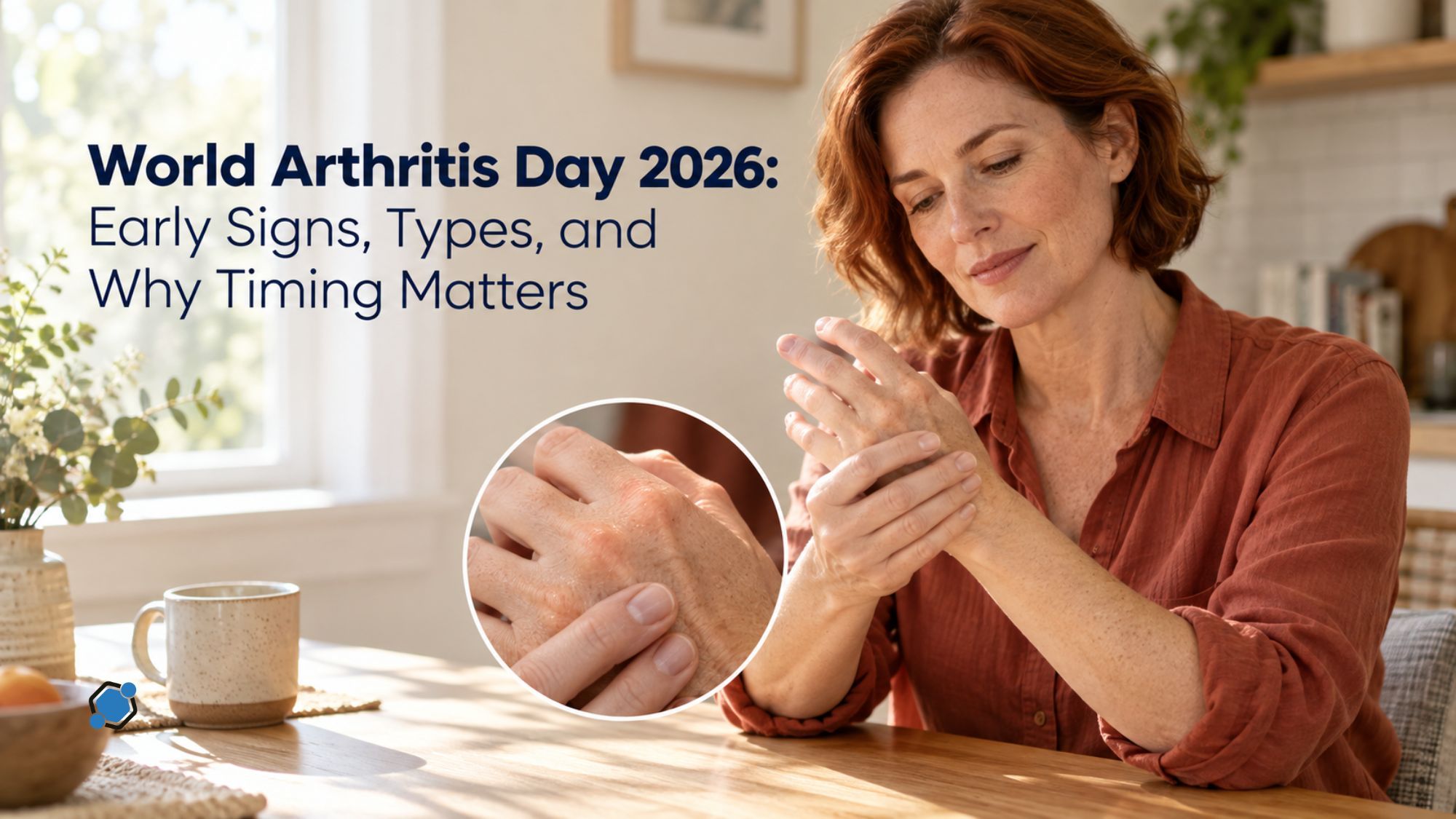
World Arthritis Day is observed on October 12 every year, and in 2026 it falls on a Monday. The date exists to correct a widespread misunderstanding. Arthritis is not a single disease that arrives with old age. It is an umbrella term covering roughly 100 conditions that affect the joints and the tissues around them, and several of those conditions begin in early adulthood or in childhood.
The practical value of the observance lies in recognition. Knowing which signs point toward an inflammatory joint condition, and understanding why the timing of a diagnosis affects what treatment can achieve, gives people a clearer basis for deciding when to seek medical evaluation.
What is World Arthritis Day, and when is it in 2026?
World Arthritis Day falls on Monday, October 12, 2026. It was first held in 1996, established by Arthritis and Rheumatism International, and is now coordinated internationally by rheumatology societies and patient organizations. The European Alliance of Associations for Rheumatology leads the global campaign and has confirmed that the 2026 observance continues the theme introduced in 2025, Achieve Your Dreams, which focuses on the personal goals people with these conditions want to keep pursuing.
The campaign uses the term rheumatic and musculoskeletal diseases, often shortened to RMDs. This is the clinical umbrella for conditions affecting joints, bones, muscles, and connective tissue, which is the supporting material that holds body structures together. The stated goals of the day are wider public recognition of symptoms, earlier diagnosis, and better access to specialist care.
The scale of the problem explains the attention. Centers for Disease Control and Prevention survey data collected from 2019 through 2021 found that 53.2 million adults in the United States, or about one in five, had been told by a doctor that they have some form of arthritis. That places it among the most common long-term health conditions in the country, alongside the chronic conditions most American adults live with.
Arthritis is not one disease
The word arthritis describes a pattern of symptoms, specifically pain, stiffness, and swelling in the joints, that many different conditions can produce. Because treatment differs sharply depending on the underlying cause, a precise diagnosis matters far more than the general label.
The most common forms include the following:
- Osteoarthritis: the most common type. The cartilage, which is the smooth cushion covering the ends of bones inside a joint, breaks down over time, and the bone underneath changes in response. It most often affects the knees, hips, hands, and spine. The World Health Organization is explicit that osteoarthritis is not an inevitable consequence of aging.
- Rheumatoid arthritis: an autoimmune condition, meaning the immune system mistakenly attacks the body's own healthy tissue. Here it targets the synovium, the thin lining inside a joint that produces lubricating fluid. It usually affects the same joints on both sides of the body, and roughly seven in ten people diagnosed are women.
- Psoriatic arthritis: inflammation of joints and tendons that develops in some people who have the skin condition psoriasis. Joint symptoms sometimes appear years after the skin symptoms, and occasionally before them.
- Gout: sudden, intense joint pain caused by uric acid crystals forming inside a joint, often beginning in the big toe. It is more common in men, and global case numbers are projected to rise substantially over the coming decades.
- Axial spondyloarthritis: inflammation centered on the spine and the joints connecting the spine to the pelvis. It typically begins in young adults rather than older ones, which is one reason it is frequently missed.
- Juvenile idiopathic arthritis: inflammatory arthritis that begins before age 16. Around 220,000 children and adolescents in the United States have been diagnosed with arthritis, and the childhood forms differ from the adult ones in both subtype and management.
National health surveys also group conditions such as lupus and fibromyalgia under the arthritis heading. Fibromyalgia causes widespread pain but does not inflame or damage joints, so it sits in the statistics without being a joint disease in the way the conditions above are.
Early signs that deserve medical attention
Inflammatory forms of arthritis tend to announce themselves differently from the mechanical joint pain people often expect. Inflammation is the body's defense response, producing heat, swelling, redness, and pain. When it does not switch off, it damages tissue over time.
Signs that warrant evaluation by a doctor include the following:
- Morning stiffness lasting 30 minutes or longer
- Visible swelling in one or more joints, particularly the knuckles or the small joints of the feet
- Joint symptoms appearing on both sides of the body at once
- Persistent fatigue alongside joint pain
- Back pain and stiffness that begins before age 45, improves with movement, and worsens with rest
Osteoarthritis usually produces a different pattern: stiffness that eases within a few minutes of moving, and pain that worsens with use through the day. That contrast is useful but not diagnostic, since conditions overlap. The combination of prolonged morning stiffness, swelling, and fatigue is the pattern most worth raising promptly with a doctor, much as it is with other autoimmune conditions that take years to recognize.
Why early diagnosis changes what treatment can do
For inflammatory arthritis, timing is not a matter of convenience. Research in rheumatoid arthritis points to what rheumatologists call a window of opportunity, generally described as the first 12 weeks after symptoms begin. Studies of early arthritis groups suggest that starting disease-modifying treatment within that period is associated with better long-term disease control than starting later, though outcomes vary considerably between individuals and no treatment timeline guarantees a particular result.
Disease-modifying antirheumatic drugs, usually abbreviated to DMARDs, are medicines that act on the disease process itself rather than only easing pain. The goal of modern care is often described as treat-to-target, meaning the doctor sets a measurable goal, usually remission or low disease activity, and adjusts treatment until that goal is reached. Remission means little or no detectable disease activity. It is not the same as a cure, and continued monitoring remains necessary.
Delays remain common in practice. Published analyses put the average time from first symptoms to a diagnosis of axial spondyloarthritis at close to seven years, and roughly two and a half years for psoriatic arthritis. Those delays reflect system-level friction rather than any single failing: symptoms fluctuate, early signs resemble common injuries, people are referred between several providers, and specialist appointments can be difficult to obtain.
What treatment looks like today, and what research is testing next
Current care combines medication with practical management. Anti-inflammatory medicines and short courses of steroids control symptoms. Conventional DMARDs form the backbone of inflammatory arthritis treatment. Biologic medicines, which are made from living cells and block one specific immune signal, and a newer class of targeted oral drugs are used when earlier options are not sufficient. The Food and Drug Administration has required prominent boxed safety warnings on that newer oral class, which is why these decisions sit with a treating specialist rather than with general guidance.
Non-drug management carries real evidence behind it. The Centers for Disease Control and Prevention recommends regular physical activity, maintaining a healthy weight, protecting joints from injury, and structured self-management education, noting that low-impact activity such as walking, cycling, and water exercise is both safe and effective for most people with arthritis. Research participation is also increasingly open across age groups, including older adults taking part in clinical research.
Active research areas differ in maturity, and the distinction matters. For osteoarthritis, no drug has yet been approved anywhere that slows or reverses the underlying joint damage, and several late-stage candidates have fallen short in large trials. In autoimmune forms such as rheumatoid arthritis and lupus, cell-based therapies adapted from cancer treatment have produced striking early results in very small numbers of patients, but these remain in early-phase studies and are not approved for routine use. Reporting that presents such findings as available treatments overstates where the evidence currently stands.
Common questions about arthritis
Is arthritis only a condition of older age?
No. Age is the strongest single risk factor for osteoarthritis, but a substantial share of adults with arthritis are under 65, axial spondyloarthritis typically begins in young adulthood, and around 220,000 American children and adolescents have a diagnosis. Treating arthritis as an older person's problem is one of the reasons younger patients wait longer for answers.
Does exercise make arthritis worse?
For most people it does the opposite. Public health guidance from the Centers for Disease Control and Prevention identifies low-impact activity as safe and effective for people with arthritis, supporting joint function and reducing pain for many. Anyone with active inflammation or significant joint damage should agree on an activity plan with their doctor or a physical therapist first.
Does cracking your knuckles cause arthritis?
Available research has not found a link. A published case-control study comparing habitual knuckle crackers with non-crackers found no meaningful difference in rates of hand osteoarthritis. The evidence base is small, so the accurate statement is that no association has been demonstrated.
How is arthritis diagnosed?
There is no single test. A doctor combines the symptom history and physical examination with blood tests that look for markers of inflammation or for antibodies associated with specific conditions, along with imaging such as X-rays, ultrasound, or MRI scans. Several of these conditions are diagnosed by a rheumatologist, a doctor who specializes in immune-related joint, muscle, and bone diseases.
Turning October 12 into one practical step
The most useful response to World Arthritis Day is specific rather than general. If joint pain has lasted more than six weeks, if morning stiffness regularly runs past half an hour, or if swelling appears in the same joints on both sides, those symptoms justify a medical appointment rather than continued waiting. If a diagnosis is already in place, the equivalent step is confirming with the treating doctor whether current disease activity is actually at target.
Clinical research is part of how arthritis care continues to improve, and participation is one option some people choose to discuss with their doctor. DecenTrialz is a platform that helps connect people with relevant studies through AI-assisted matching, registered-nurse-led pre-screening, and structured referral to research teams. The platform does not determine eligibility or enroll anyone. The authorized research site and study team handle all eligibility decisions, informed consent, and enrollment. For readers weighing whether to explore this route, it helps to understand how trial matching services work before sharing any personal health information.
Was this article helpful?

Similar Blogs

OCD Awareness Week 2026: symptoms, myths, and the research gap
OCD Awareness Week 2026 runs October 11 through October 17 and marks the second full week ...
 Mahesh Upadrista
Ischemic vs hemorrhagic stroke: what causes each and how they differ
A stroke happens when blood flow to part of the brain is disrupted. There are two main kin...
Deeksha Gitta
World Mental Health Day 2026 and the push for lived experience
World Mental Health Day falls on Saturday, October 10, 2026, and this year’s theme marks a...
 Anish Teepireddy
Stay Informed. Stay Connected.
Get updates on verified clinical trials, emerging treatments, and research breakthroughs directly in your inbox. No spam, just science that matters.
