 HIPAA Compliant
 ISO 27001 Certified
DecenTrialz vs. EMR-based clinical trial recruitment tools: what actually delivers qualified participants for sponsors and CROs?
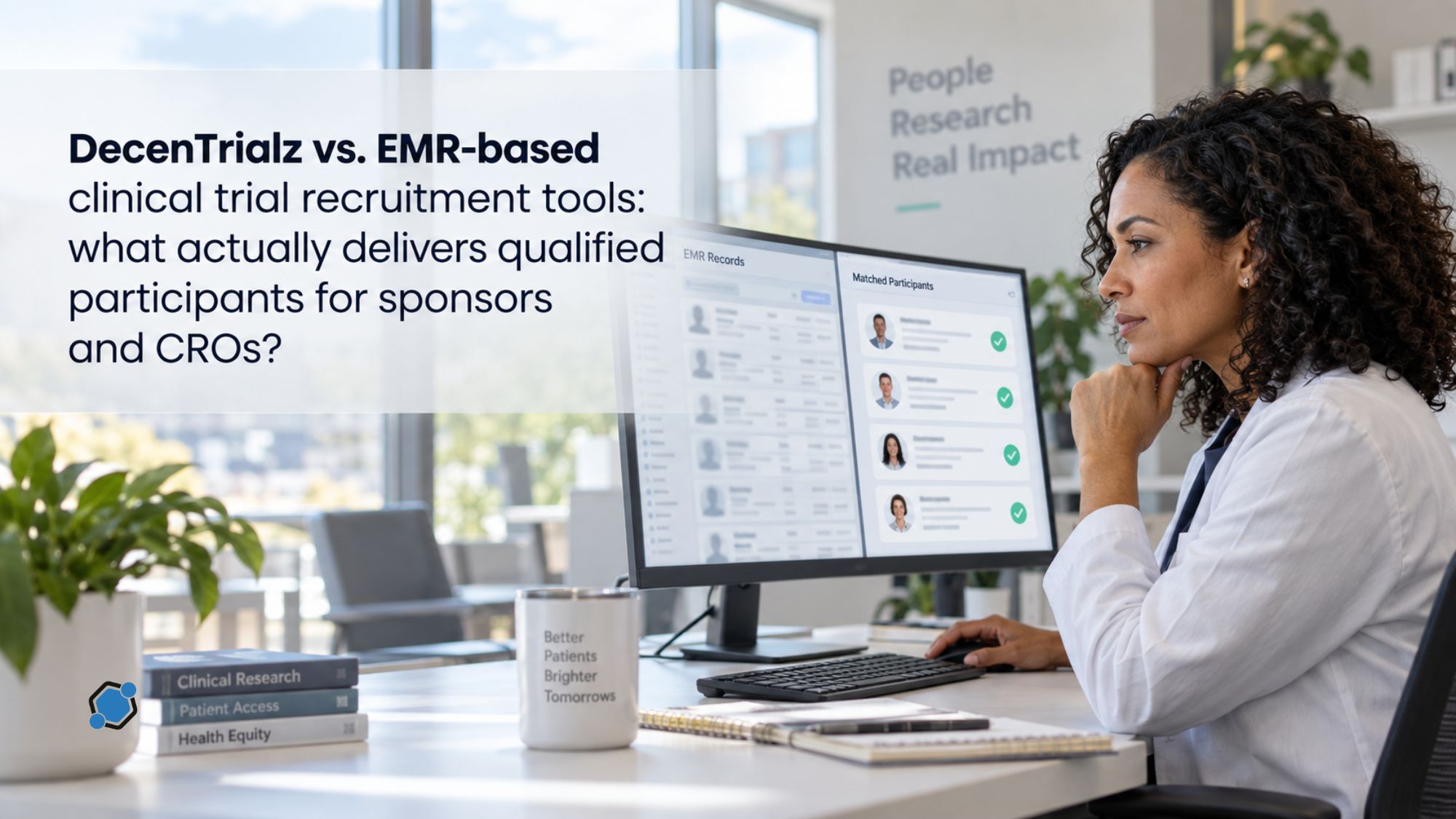
Clinical trial recruitment technology now divides into two broad philosophies. One prizes breadth of reach, scanning the electronic records of an entire health system to surface every patient who might fit a study. The other prizes depth of verification, confirming through structured human conversation that a candidate is genuinely eligible, available, and willing before a research site ever opens a chart. For sponsors, the organizations that fund and own a trial, and CROs, the contract research organizations sponsors hire to run trials, understanding where each approach adds value and where it quietly creates cost is now central to hitting enrollment timelines.
This analysis compares EMR-based recruitment tools with a model that pairs AI-assisted matching with registered nurse-led pre-screening. The goal is not to crown a winner but to show why cohort count and conversion rate measure two very different things.
How EMR-based recruitment tools find patients at scale
EMR-based recruitment tools work by querying the electronic medical record, or EMR, and the electronic health record, or EHR, which are the digital records a health system keeps on the patients it treats. These platforms translate a study protocol, the document that defines exactly who can join a study and how the trial runs, into machine-readable rules. They then apply those rules across a health system’s patient population to assemble a cohort, meaning a group of potentially eligible patients.
Modern versions go beyond structured fields such as diagnosis codes and lab values. They apply natural language processing, or NLP, a form of AI that reads unstructured free text, to mine clinician notes, pathology reports, and imaging summaries for details that never made it into a tidy checkbox. This is genuine capability. Sophisticated AI-assisted patient matching can evaluate hundreds of data points per patient in seconds and can condense a population of many thousands into a focused shortlist for review.
The strengths are real and worth naming. EMR-based tools deliver speed of initial identification, the ability to interrogate a very large population inside a single health system, near-real-time refresh as new data arrives, and tight integration with existing clinical workflows. For feasibility, the exercise of estimating whether enough eligible patients exist before a trial opens, this reach is valuable. When a condition is common and the eligibility logic maps cleanly onto coded data, breadth of reach is a strong opening move.
Where breadth of reach runs into its limits
The catch is that a cohort count is not a list of enrollable patients. Several structural issues sit between the two.
First, data quality. EHR data is recorded for care and billing, not for research, so fields are often missing, outdated, or inconsistent across systems. NLP over free text is powerful but imperfect, and simple keyword logic can misread negation, family history, and speculative language, which inflates a cohort with false positives. When a raw list is handed to a site without human pre-screening, those false positives convert into screen failures, cases where a consented candidate is found ineligible once formal screening begins. This is a major driver of the cost of screen failures that sponsors absorb across a trial.
Second, the data simply does not contain much of what a protocol requires. Recent medication changes, current symptom severity, lifestyle factors, and social determinants of health, meaning the conditions in which people live and work that shape their ability to participate, are discussed in visits but rarely captured in structured fields. None of this is a failing of any individual patient or clinician. It is a system-level reality of how records are built.
Third, reach is bounded by where a patient receives care. Patients routinely split their care across multiple unaffiliated health systems, so any single EMR holds only a fragment of the longitudinal picture. A tool that is EMR-native is therefore blind to eligible patients treated elsewhere and can overestimate eligibility for the patients it does see.
Finally, the EMR says nothing about willingness. It cannot tell a sponsor whether a patient understands what the trial involves, is willing to travel to the site, or is prepared to comply with the study procedures. Those answers exist only in conversation.
Why AI matching alone produces high screen failure rates
The most important recent shift in how the field talks about AI matching came from a large randomized study conducted at a major academic cancer center. It tested whether AI-triggered notifications to treating physicians, prompting them about genomically matched trials at the moment a patient’s disease progressed, would lift enrollment. The design was elegant and the AI performed well at detecting the clinical trigger. The result was null: patients whose physicians received the notifications were no more likely to enroll than those in the control group.
The lesson researchers and industry commentators have drawn is that matching accuracy, while necessary, is not sufficient. The dominant bottleneck to enrollment is systemic, involving logistics, workflow misalignment, and the burden of consent and study visits, rather than a lack of information about who might fit. An accurate list, delivered at the right time, does not by itself move enrollment. This reframing matters because much of the real cause of slow enrollment is incurred precisely when qualified-looking candidates fail to convert.
This is why AI matching alone, whether EMR-based or otherwise, tends to produce high screen failure rates. The model optimizes for finding candidates who resemble the criteria on paper. It does not verify the perishable, context-dependent facts that determine real eligibility, and it does not build the human rapport that carries a candidate from interest to enrollment.
How RN-led pre-screening adds depth of verification
Depth of verification is where a registered nurse, or RN, changes the economics. RN-led pre-screening inserts a structured clinical conversation between AI-assisted matching and the referral to a research site. A nurse works through the protocol’s inclusion and exclusion criteria, meaning the specific requirements a patient must meet, and confirms the very things the EMR cannot: recent medication changes, current symptoms, comorbidities that never got coded, and the patient’s own understanding of what participation requires.
Equally important, the nurse assesses the human factors that determine whether a match becomes a participant. Is the person willing and able to travel to the site? Can they commit to the visit schedule and the study procedures? Do they understand, in plain terms, what the trial involves before anyone asks them to proceed? A closer look at what nurse review adds shows how this filter removes clearly ineligible or unavailable candidates before site resources are consumed, which may help reduce downstream screen failures and the associated burden on coordinators.
There is a clinical-quality dimension too. A trained clinician conducting consistent, structured pre-screening reduces the variability that arises when many different people ask questions in different ways. That consistency supports the data reliability that regulators increasingly expect.
DecenTrialz operates on this model, combining AI-assisted matching with registered nurse-led pre-screening to deliver verified, qualified referrals rather than raw lists. The research site team owns the final eligibility determination, informed consent, the study walk-through, and enrollment. Pre-screening informs the site’s decision; it never replaces it.
What sponsors and CROs should weigh: cohort count vs. conversion
The core trade-off is breadth versus depth, and it shows up directly in the metrics each approach optimizes.
EMR-based tools optimize cohort count and speed of identification within a health system. A verified pipeline optimizes conversion, meaning the share of referred candidates who actually enroll. A large cohort that converts poorly can be more expensive than a smaller cohort that converts well, because every screen failure carries direct cost in coordinator time, laboratory work, and site capacity, and because slow enrollment carries a substantial per-day cost in trial conduct and deferred value. This is why an emphasis on referral quality over volume has become a defining feature of modern recruitment planning. A qualified referral is a candidate whose protocol-specific eligibility and willingness have been verified by a human before the site invests in a screening visit.
The regulatory direction reinforces the case for verification. The updated Good Clinical Practice guideline known as ICH E6(R3), the international framework for how trials should be conducted ethically and reliably, shifts emphasis from data integrity toward data reliability and a fitness-for-purpose standard, and it defines reliability in terms of accuracy, completeness, and traceability. It also elevates patient-centricity, recognizing that meaningful participant engagement supports better recruitment, retention, and data quality. Regulators have separately pushed sponsors toward broader, more representative enrollment. Structured human pre-screening speaks to both aims: it improves the reliability of who reaches the site, and it opens a channel to engage candidates that a cross-system, verified pipeline can reach even when they receive care outside a single health system.
There is also a protocol-design angle. A leading driver of substantial protocol amendments, which are costly formal changes to a finalized protocol, is revisions to eligibility criteria and the study population, often prompted by difficulty recruiting patients. Verified pre-screening surfaces real-world eligibility friction early, which may help teams pressure-test criteria before they become expensive amendments.
Frequently asked questions
What is the difference between a cohort count and a qualified referral?
A cohort count is the number of patients an algorithm flags as potentially matching a protocol based on available data. A qualified referral is a candidate whose protocol-specific eligibility and willingness to participate have been verified through human pre-screening before referral to a site. The first measures reach; the second predicts conversion.
Do EMR-based tools and RN-led pre-screening compete or complement each other?
They are largely complementary. AI-assisted matching, including EMR-based approaches, is well suited to casting a wide net and prioritizing candidates. RN-led pre-screening is suited to verifying the perishable, context-dependent facts that determine true eligibility. Used together, breadth feeds depth.
Does human pre-screening slow recruitment down?
It adds a step, but it targets the step that most often fails. By filtering out candidates who would screen fail or decline, verified pre-screening may help protect site capacity and shorten the path from identification to randomization, meaning the point at which a participant is formally assigned within the study.
Why can AI matching miss eligible patients or flag ineligible ones?
Records are recorded for care, not research, and are often incomplete or split across unaffiliated health systems. Free-text analysis can also misread context. These are system-level data limitations, not individual failings, and they are exactly what human verification is designed to catch.
Choosing depth and breadth together
Breadth of reach and depth of verification are not rival ideologies so much as different stages of the same funnel. EMR-based tools answer the question of who might qualify inside a health system, quickly and at scale. RN-led pre-screening answers the harder question of who actually qualifies, is available, and is willing, across care settings and before a site spends a screening visit finding out. Sponsors and CROs that treat cohort count as the finish line tend to inherit the screen failures downstream; those that measure conversion tend to design for verification from the start. Teams weighing a verified referral pipeline are welcome to explore how AI-assisted matching paired with registered nurse-led pre-screening could fit their next protocol.
Was this article helpful?

Similar Blogs
International Week of Deaf People 2026: how can clinical research become accessible to Deaf participants?
More than seventy million people around the world belong to signing Deaf communities, and ...
 Deeksha Gitta
Visceral Fat Health Risks: What Makes Belly Fat Different From Other Body Fat?
Body fat is usually discussed as a single quantity, weighed on a scale and summarized in o...
 Anish Teepireddy
World Alzheimer's Day 2026: What Is It, and Why Does Early Diagnosis Matter?
On September 21, 1994, Alzheimer's Disease International held the first World Alzheimer's ...
Mahesh UpadristaStay Informed. Stay Connected.
Get updates on verified clinical trials, emerging treatments, and research breakthroughs directly in your inbox. No spam, just science that matters.
