 HIPAA Compliant
 ISO 27001 Certified
How is a clinical trial recruitment platform different from a trial finder website? Inside DecenTrialz's AI matching and RN pre-screening
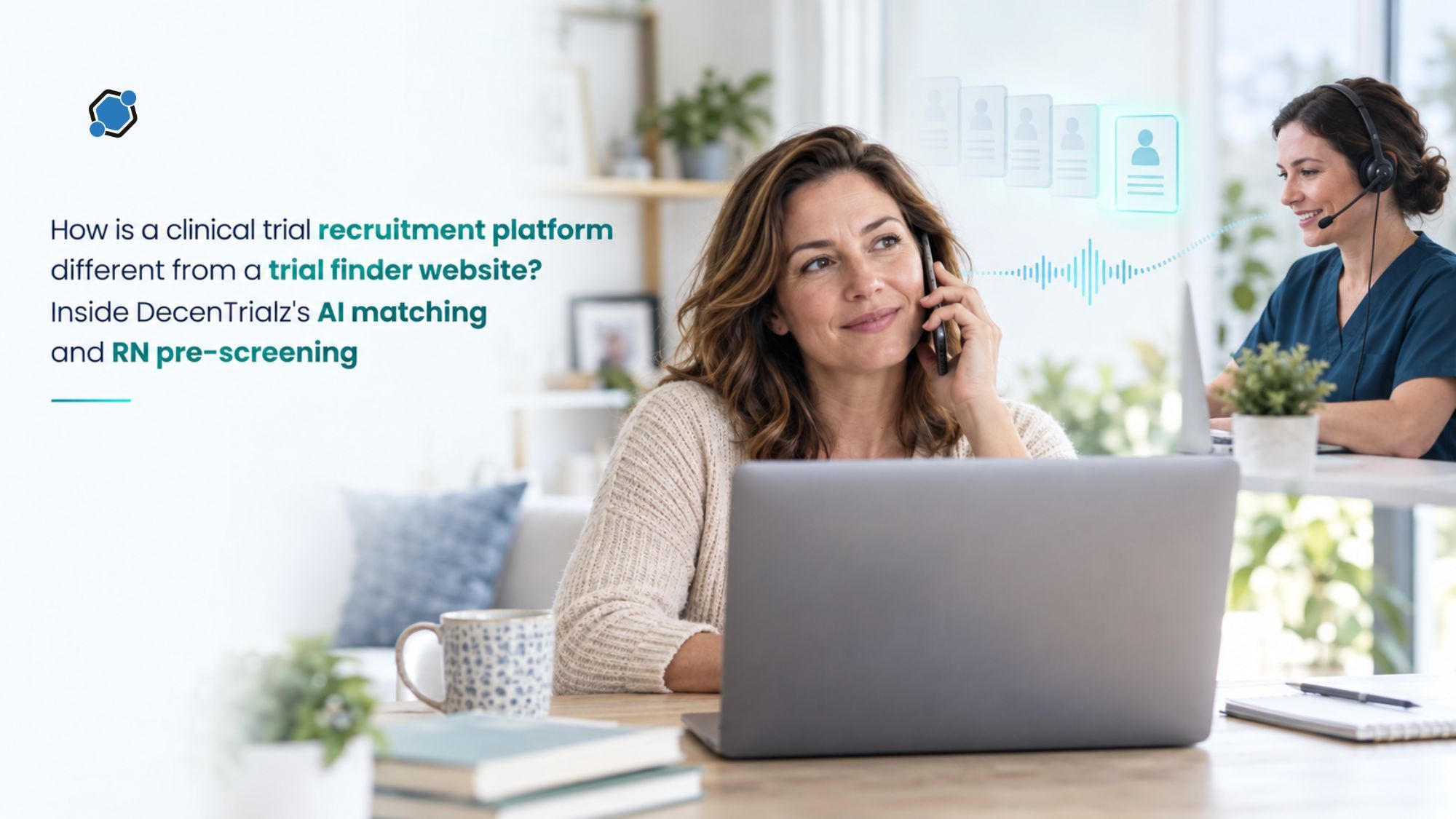
Public clinical trial finder websites are, at their core, disclosure directories. They exist so that anyone can look up which studies are open, who is running them, and where they are being conducted. That transparency function is genuinely important for research accountability. It is also very different from the job most sponsors and contract research organizations (CROs) need done, which is moving a specific patient to a specific site fast enough to hit an enrollment target.
The gap between those two jobs is structural. A directory is not a matching engine, and a keyword search over free-text eligibility criteria is not a pre-screening workflow. For sponsors and CROs weighing where to invest recruitment budget, the more useful question is a mechanical one: what actually changes in the search when the tool sitting between the patient and the site is designed for recruitment rather than for disclosure?
DecenTrialz is a U.S.-based clinical trial recruitment platform that pairs AI-assisted participant matching with registered-nurse (RN)-led pre-screening. Final eligibility determination, informed consent, study walk-through, and enrollment remain with the research site team. This article compares what a general trial finder does, mechanically, with what a matching-plus-pre-screening platform does, and explains why the difference matters for time, cost, and funnel visibility.
Public trial finder websites were built for transparency, not for recruitment
A public trial finder is a searchable database of study records. Each record contains structured metadata such as condition, phase, status, sponsor type, and location, plus a large block of unstructured text that lists the inclusion and exclusion criteria. The search engine matches typed words against those text fields and applies filters against the structured metadata.
Mechanically, that is the entire tool. What the visitor sees is a ranked list of study records. The visitor then opens each record, reads the criteria, and self-navigates to a site contact. Nothing sits between reading the record and contacting the site, because the system was not designed to qualify anyone. The registry publishes; the patient decides; the coordinator sorts.
For a sponsor or CRO, this creates a specific operational problem. Inbound generated through a public directory arrives at the site with no upstream validation. The coordinator becomes the first and only filter, working through contacts of unknown quality alongside every other administrative demand at the site. That workflow was not designed around recruitment either. It is the byproduct of using a transparency tool as if it were a recruitment engine, and it is where slow enrollment often begins. Sponsors trying to diagnose why studies stall benefit from separating volume problems from quality problems, an issue explored in how sponsors find the real cause of slow clinical trial enrollment.
Why keyword search over eligibility criteria falls short for recruitment
Inclusion and exclusion criteria are written for trained research staff to implement. They are dense with clinical language, numeric thresholds, temporal constraints, and negations, small words such as no, prior, and except that flip an inclusion into an exclusion. A single protocol can carry dozens of interdependent eligibility variables, and the whole block typically requires a reading level well above the average adult.
A keyword search cannot reason about that text. It matches words, not clinical meaning. It cannot ask how many prior lines of therapy a person has had, whether a recent lab value falls inside a required range, or whether a comorbidity that appears in the exclusion list actually applies to the candidate. Those variables sit inside the free text, unsearchable and un-parseable by a general finder.
Self-selection then breaks in both directions. Patients who could genuinely qualify rule themselves out because they cannot interpret the criteria. Patients who cannot qualify rule themselves in because they misunderstand the criteria. The first outcome is invisible to the sponsor and shows up as missed enrollment. The second outcome is highly visible: it becomes a screen failure at the site, consuming coordinator time, a screening visit, and often the patient's willingness to keep engaging with research. In practice, this is why referral quality predicts enrollment better than referral volume for most study teams.
What AI-assisted matching changes in the actual search
An AI-assisted matching platform re-engineers the search from both ends. On the trial side, natural language processing reads the eligibility text and converts it into machine-readable rules, recognizing entities such as conditions, drugs, and labs, along with numeric thresholds, temporal constraints, and negations. Once criteria are structured, the trial becomes searchable by what it actually requires, not by which keywords happen to appear in its record.
On the patient side, a structured intake questionnaire replaces the free-text search box. Dynamic branching logic asks only the questions that remain relevant based on prior answers, progressively narrowing toward the criteria that actually rule trials in or out. A vague self-description becomes a structured clinical profile the system can reason about.
The profile and the parsed criteria are then compared semantically. Instead of a flat list of keyword hits, the platform returns ranked and graded matches: clear fits, probable fits, and likely exclusions. Matching can also incorporate geography and site capacity so that a qualified candidate is routed toward a site that is actually positioned to enroll them, rather than to a generic study record with many locations. Sponsors and CROs evaluating this layer benefit from a clear framework for what good looks like, which is unpacked in what CROs should look for in an AI-assisted patient matching model.
The realistic caveat is that AI matching against self-reported inputs is not perfect. It narrows and prioritizes; it does not decide. The current consensus in the field treats AI matching as decision support that must be validated by a human, which is exactly where the next layer sits.
Where RN-led pre-screening changes the funnel
Between the online match and the site's formal screening visit, DecenTrialz places a registered nurse. The RN conducts a structured, IRB-approved conversation to confirm the AI match against the candidate's actual clinical picture, resolves contradictory or unclear answers, probes medication and prior-therapy history in greater depth, and assesses motivation and logistical fit. What software applies as fixed logic to whatever was typed, a nurse can interpret in clinical context.
The scope boundary here is important and must be stated plainly. Pre-screening is not screening. The RN gauges likely eligibility against inclusion and exclusion criteria using an approved script. The RN does not obtain informed consent, does not perform protocol-defined labs, imaging, or physical examinations, and does not make the final eligibility determination. Those responsibilities remain with the research site and study team.
What the site receives is a warm handoff: a real-time, human-facilitated introduction of an already-engaged, pre-qualified candidate. Cold inbound leads must self-initiate the next step and often stall there. Pre-qualified referrals arrive with the ambiguities already worked through, which reduces the number of avoidable screen failures downstream. The distinction between what AI adds and what nurse review adds is examined in more depth in what nurse review adds that AI matching cannot.
What sponsors and CROs actually see when the search is instrumented
The most operationally important change for sponsors and CROs is not that individual referrals are better, though they are. It is that the funnel becomes visible for the first time. Public trial finders produce essentially no operational feedback, because feedback was never their purpose. A matching-plus-pre-screening platform is instrumented at every stage.
Each step is captured: reached, matched online, pre-screened by RN, referred to site, consented, and randomized. That data flows into a real-time recruitment dashboard rather than being reconstructed after the fact from disconnected site reports. Cross-site funnel visibility means that when one site under-enrolls, the platform can redirect pre-qualified candidates toward it, or shift volume away, because the referral flow is controlled centrally. The specific views that matter at the sponsor level are described in what a recruitment dashboard should show sponsors in real time.
The metrics that emerge are also different. Instead of counting contacts, sponsors and CROs can measure qualified-referral-to-randomization conversion, screen-failure rates by site, and time from referral to enrollment. Diversity of enrollment can be tracked in the funnel itself and addressed while the study is still open rather than after database lock. Predictive feasibility signal appears earlier, because the same funnel that recruits also reports where friction is building.
A useful mental shift lands here for sponsor and CRO teams. Enrollment stalls are frequently misdiagnosed as a patient-supply problem, prompting more volume to be poured into an unfiltered workflow. The matching-plus-pre-screening model targets quality and visibility rather than raw volume, which is the point of separating a recruitment layer from a disclosure directory in the first place.
Frequently asked questions from sponsors and CROs
Is DecenTrialz a replacement for public trial finder websites?
No. Public trial finder websites serve a transparency and disclosure function that remains essential. DecenTrialz is a recruitment layer that pairs AI-assisted matching with RN-led pre-screening and structured referral to the site team. The two categories of tool do different jobs.
Does the RN determine whether a candidate is eligible for a study?
No. The RN conducts pre-screening only, using an IRB-approved script to assess likely eligibility. Final eligibility determination, informed consent, protocol-defined procedures, and enrollment remain with the research site team.
What kinds of metrics can sponsors and CROs actually see in real time?
Metrics generated by an instrumented recruitment funnel include qualified-referral volume by site, screen-failure trends, referral-to-randomization conversion, time-to-first-patient, and demographic composition of the pipeline.
Does AI matching remove the need for human review?
No. AI matching narrows and ranks. Human review, in the form of RN pre-screening at the platform layer and full screening at the site, is what turns a ranked match into a qualified candidate and then into an enrolled participant.
Choosing the right recruitment layer for the study
A trial finder website is the right tool for disclosing that a study exists and letting the public look it up. A recruitment platform is the right tool for actively matching, validating, routing, and measuring candidates against a specific protocol. Sponsors and CROs evaluating where to invest recruitment budget benefit from being explicit about which job the tool in question is being asked to do.
DecenTrialz sits in the recruitment layer. It combines AI-assisted participant matching with RN-led pre-screening and warm handoff to the research site, and it reports the full funnel back to the sponsor or CRO in real time. To explore whether the platform fits a specific study, contact the DecenTrialz team.
Was this article helpful?

Similar Blogs
Triple Negative Breast Cancer: What Does It Mean, and Why Is It Harder to Treat?
Triple negative breast cancer is a specific subtype of breast cancer defined less by what ...
 Paramraj
International Week of Deaf People 2026: how can clinical research become accessible to Deaf participants?
More than seventy million people around the world belong to signing Deaf communities, and ...
Deeksha Gitta
DecenTrialz vs. EMR-based clinical trial recruitment tools: what actually delivers qualified participants for sponsors and CROs?
Clinical trial recruitment technology now divides into two broad philosophies. One prizes ...
Vamshi KantojuStay Informed. Stay Connected.
Get updates on verified clinical trials, emerging treatments, and research breakthroughs directly in your inbox. No spam, just science that matters.
