 HIPAA Compliant
 ISO 27001 Certified
What is a Dose-Escalation Study? How Researchers Find the Highest Safe Dose of a New Drug
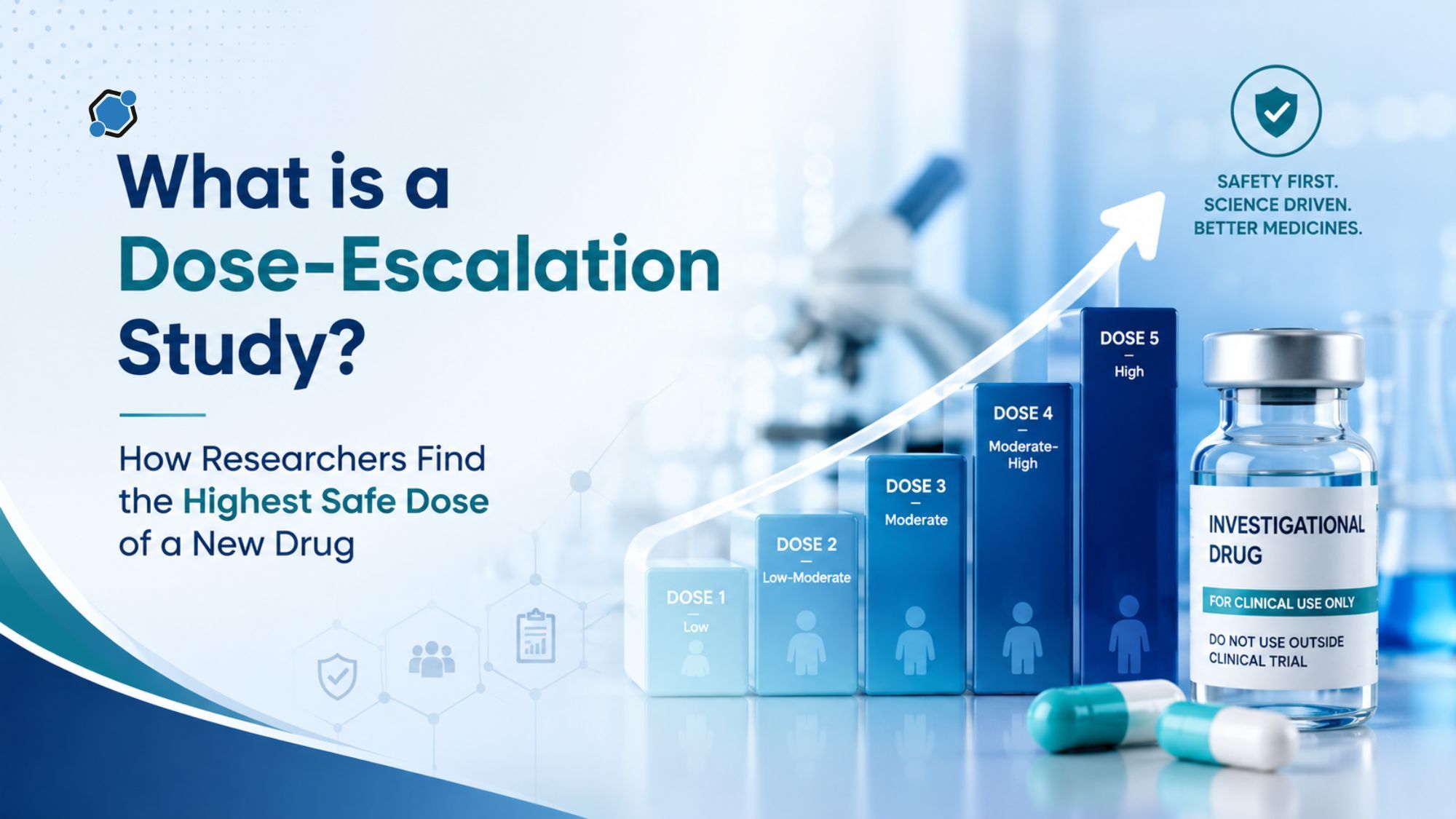
What is a dose-escalation study? In simple terms, a dose-escalation study is the first stage of testing a new drug in people, designed to find the highest dose a person can take without unacceptable side effects. These studies are most common in cancer research, but they also test new heart medicines, immune therapies, and gene therapies. The study moves slowly and carefully: a small group takes a tiny dose, researchers watch for problems for several weeks, and only if that group is safe does the next group take a slightly higher dose.
What is a Dose-Escalation Study?
A dose-escalation study is a Phase 1 clinical trial designed to identify the safe and tolerable dose range of a new drug. The defining feature is sequential dosing. Small groups of participants, called cohorts, each receive a specific dose level. Dosing only progresses to a higher level after the previous level is judged safe.
These studies almost always happen at the very start of human testing. Before this point, the drug has been tested only in laboratory cells and in animals. The dose-escalation study answers the first question every drug must clear: at what dose can the human body handle this compound. Without that answer, no later-phase trial can be designed responsibly.
A typical dose-escalation study enrolls between 20 and 60 participants across several dose levels. The study can run for a year or longer, since each cohort must be observed for weeks before the next cohort begins. The pace is deliberate, not slow by accident.
Why Dose-Escalation Studies Exist in Drug Development
Dose-escalation studies exist because the first dose given to any person is, by definition, an educated guess. Animal data suggests a starting point, but human bodies respond differently. A dose that was safe in mice can be too high in people. A dose that worked well in animals can fail to work at all in humans.
The starting dose in a dose-escalation study is set deliberately low. Most researchers start at roughly one-tenth of the dose that caused the first sign of toxicity in animals, scaled to human body size. The intent is to create a wide safety margin at the beginning, then climb only as evidence allows.
This careful approach was not always standard. The modern framework was shaped by drug safety failures of the 20th century, including thalidomide in the late 1950s, which caused severe birth defects after being approved without rigorous human safety testing. The structured dose-escalation approach used today is the result of decades of reform.
Some drugs enter dose-escalation studies after a Phase 0 trial, which uses microdoses to study how the drug behaves in the human body before any therapeutic dose is given. Readers interested in this earlier stage may find Phase 0 Clinical Trials: What They Are and Why They Exist useful for context, since the two designs often work together at the very start of human testing.
How a Dose-Escalation Study Works: The 3+3 Design
A dose-escalation study works on one principle: never give a higher dose until the current dose has been tested. The most common method for putting this principle into practice is called the 3+3 design, used in more than 95 percent of Phase 1 cancer trials.
The 3+3 design works in three steps. First, three participants are enrolled at the starting dose. They receive the study drug and are monitored for a defined observation period, typically 28 days. During this window, researchers track every side effect, blood test, and clinical sign.
Second, the decision rule is applied. If none of the three participants experiences a serious side effect that meets the definition of a dose-limiting toxicity, the study moves to the next, higher dose level with a new group of three participants. If one of the three does experience a dose-limiting toxicity, the cohort is expanded to six participants at that same dose. If a second person in that expanded cohort also experiences a dose-limiting toxicity, dose escalation stops. The dose level below that point is considered the maximum tolerated dose.
Third, the cycle repeats. Each new cohort climbs the dose staircase one step at a time, with the same wait-and-watch period before moving on. A study may include four to seven dose levels, and the total enrollment grows with the number of levels tested.
The 3+3 design is popular because it is simple, requires no statistical software to run, and can be approved quickly by ethics committees. Researchers also use other methods, including Bayesian designs and accelerated titration, which can identify the safe dose with fewer participants. The 3+3 design remains the default in most cases.
Participants in a dose-escalation study go through a particularly thorough informed consent process, since the risks of a new drug at a previously untested dose are not fully known. The consent document explains the available animal data, the dose levels planned, the monitoring schedule, and the right to withdraw at any time. Readers can learn more about this process in How to Read Your Informed Consent Form Before Joining a Clinical Trial.
Dose-Limiting Toxicities and the Maximum Tolerated Dose
Two terms decide the result of a dose-escalation study: dose-limiting toxicity and maximum tolerated dose. Both have specific definitions that the study team commits to before any participant is enrolled.
A dose-limiting toxicity, often shortened to DLT, is a side effect serious enough to prevent further dose escalation. The exact threshold is defined in the study protocol. In most cancer dose-escalation studies, a dose-limiting toxicity is a serious side effect that is clearly related to the study drug and that meets a specified severity level on the standard adverse event grading scale used in cancer research. Examples include severe drops in white blood cell count that lead to infection, severe liver function changes, or any side effect serious enough that the participant cannot continue receiving the study drug safely.
The maximum tolerated dose, often shortened to MTD, is the highest dose at which the rate of dose-limiting toxicities stays below a defined threshold. The standard threshold in cancer trials is 33 percent. Put plainly: if fewer than one in three participants at a given dose level experiences a dose-limiting toxicity, that dose is considered tolerable. If more than one in three does, dose escalation stops and the dose level below it is named the maximum tolerated dose.
Once the maximum tolerated dose is identified, it becomes the dose that moves forward into the next phase of testing. For many drugs, this dose is also called the recommended Phase 2 dose, which is the dose Phase 2 trials will use to study whether the drug actually works.
The maximum tolerated dose is not the same as the optimal dose. A drug can be safely given at its maximum tolerated dose without that dose being the most effective. The clinical research community is increasingly aware of this gap, particularly for targeted cancer drugs and immune therapies, where the dose that produces the strongest biological response can be lower than the maximum the body can tolerate. Research practice is gradually shifting toward identifying an optimal dose rather than only a maximum, though the maximum tolerated dose remains the standard output of a Phase 1 dose-escalation study.
Who Can Participate in Dose-Escalation Studies
Participants in dose-escalation studies are typically patients with serious illnesses whose standard treatments have not worked. This is most common in cancer, where the study population is often patients with advanced disease who have exhausted approved options. Other dose-escalation studies enroll patients with rare diseases, severe autoimmune conditions, or hereditary disorders where no good standard care exists.
A smaller number of dose-escalation studies use healthy volunteers. This is more common for drugs intended for non-life-threatening conditions, such as some heart medicines, antihistamines, or hormone therapies, where the safety profile in healthy people gives a clean baseline before testing in patients with the actual condition. Drugs intended for serious diseases like cancer are almost never tested in healthy volunteers, since the potential for serious side effects makes the risk-to-benefit balance unacceptable.
Eligibility for a dose-escalation study is narrow. Researchers look for participants whose other health conditions and medications will not confuse the safety data. They also look for participants with measurable disease, since each dose-escalation study includes some early signals of biological activity. Most studies set specific limits on age, body weight, kidney and liver function, blood cell counts, and prior cancer therapies.
These narrow criteria mean that many people who hope to join a dose-escalation study learn that they do not qualify. The reasons range from a recent medication that overlaps with the study drug, to a lab value just outside the eligibility range, to a prior therapy that makes safety signals harder to read. Readers can learn more about why this happens in Why People Get Screened for Clinical Trials and Still Don't Get In.
What Happens After a Dose-Escalation Study
After the maximum tolerated dose is identified, the study often continues with what is called an expansion cohort. This is a larger group of participants, typically 10 to 30 people, all of whom receive the maximum tolerated dose. The expansion cohort provides a clearer picture of safety at the chosen dose and gives early signals of whether the drug is working in a specific patient population.
The next step is a Phase 2 trial. Phase 2 trials use the dose identified in the dose-escalation study and focus on a different question: does the drug actually help. They enroll more participants, usually 100 to 300, and study the drug in a more defined patient group.
If Phase 2 results suggest the drug helps, the drug moves into Phase 3 trials, which compare the new drug to existing therapies in larger groups of patients. Phase 3 trials are the basis for approval applications submitted to drug regulators.
The dose chosen in the dose-escalation study influences every step that follows. A dose set too high carries side-effect burden into later trials. A dose set too low can make a useful drug look ineffective. This is why the field is paying more attention to dose optimization, not just dose escalation, and why the difference between how well a drug performs in clinical trials and how well it works in everyday practice is a topic of ongoing research. Readers interested in this distinction may find Efficacy vs. Effectiveness in Clinical Trials: Why One Drug Can Have Two Different Numbers useful.
Every approved drug on the market today has been through a dose-escalation study at some point in its development. The careful, deliberate dose-climbing protocol that defines these studies is the reason modern medicines have known safe ranges, defined side-effect profiles, and recommended doses tailored to specific populations. It is also why the path from a promising laboratory finding to an approved drug takes years rather than months.
For patients considering participation in early-phase clinical research, the choice involves real risks and real responsibility. DecenTrialz is a platform that connects people to clinical trials they may be eligible for. Matching is AI-assisted, a nurse pre-screens each potential participant before referral to a study site, and the research team running the study makes all final eligibility and enrollment decisions, since they are the ones responsible for the participant's care during the trial. For readers interested in starting that search, DecenTrialz Explained: How to Search, Read, and Apply for Clinical Trials walks through how the platform works.
Was this article helpful?

Similar Blogs

Health Unit Coordinator Day: the behind-the-scenes team that helps clinical trials run
Every August 23, the United States recognizes Health Unit Coordinator Day. The date honors...
 Paramraj
Patient tokenization in clinical trials: How sponsors link trial data to real-world outcomes
Real-world data has moved from a supporting cast in clinical development to a central char...
Paramraj
Home nursing visits in clinical trials: what participants can expect
Clinical trial visits are starting to look different. In a growing number of studies today...
Vamshi KantojuStay Informed. Stay Connected.
Get updates on verified clinical trials, emerging treatments, and research breakthroughs directly in your inbox. No spam, just science that matters.
