 HIPAA Compliant
 ISO 27001 Certified

COPD Awareness Month 2026: what is COPD, and why does early diagnosis matter?
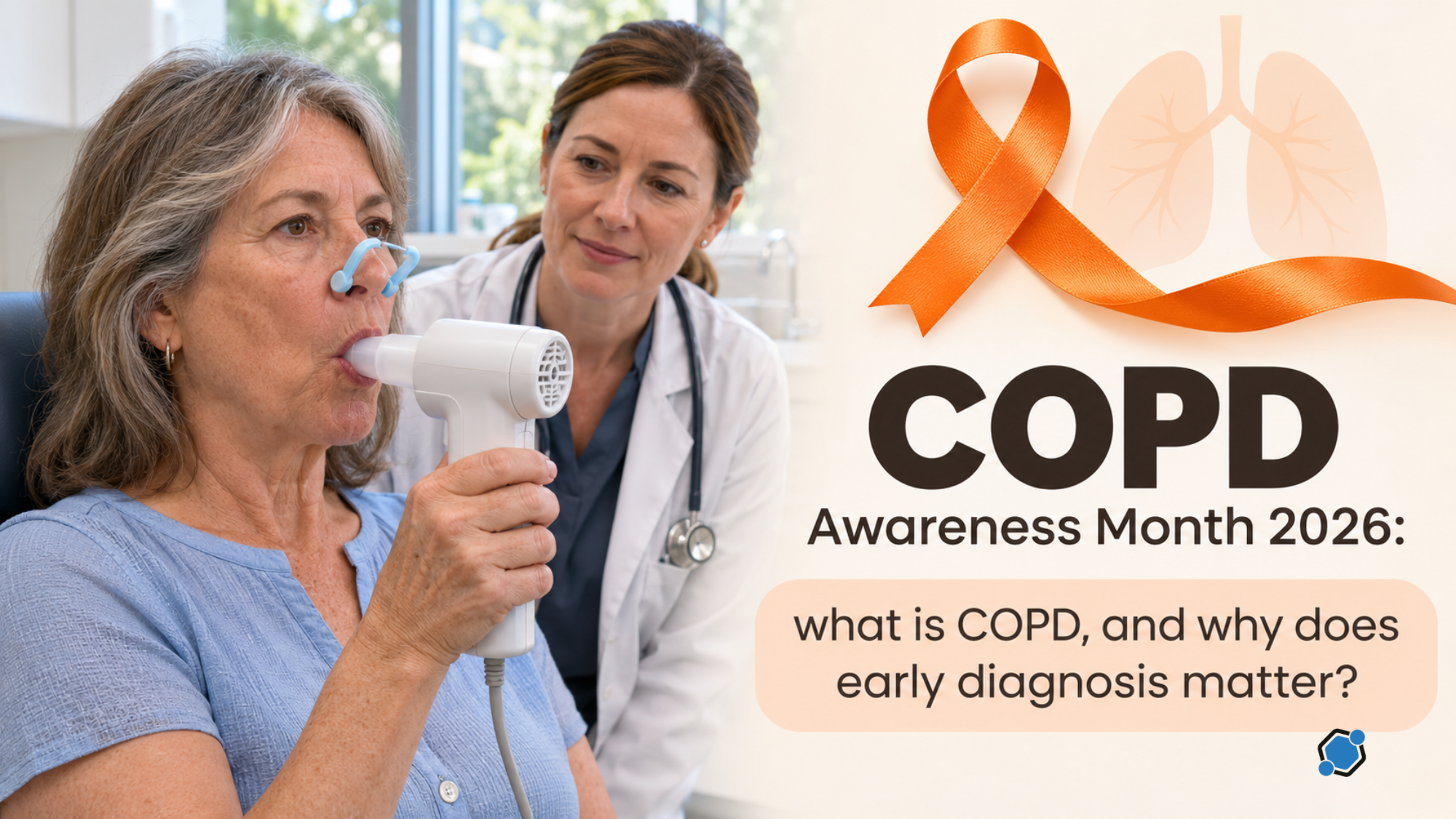
Shortness of breath on a flight of stairs is easy to blame on age, extra weight, or a lack of exercise. For many adults, it is one of the first signs of chronic obstructive pulmonary disease (COPD), a long-term lung disease that often goes unrecognized for years. November is COPD Awareness Month in the United States, and World COPD Day falls on Wednesday, November 18, 2026. The 2026 global theme, "Early Diagnosis and Management for a Better Life," focuses on the gap between when COPD begins and when people learn they have it.
What is COPD, and why does COPD Awareness Month matter?
COPD is a group of lung conditions that make it hard to move air out of the lungs. Doctors call this airflow limitation, and it does not fully reverse with treatment. Healthy lungs work like branching tubes that end in clusters of springy, balloon-like air sacs: air flows in, and the sacs recoil to push it back out. In COPD, that system breaks down in one or both of two ways:
- Emphysema, in which the tiny air sacs are damaged and lose their stretch, so air gets trapped inside the lungs
- Chronic bronchitis, in which the airways stay inflamed and produce extra mucus, causing a cough that lasts for months and keeps coming back
Many people have features of both. COPD is sometimes confused with asthma because the two share symptoms such as wheezing and breathlessness. Asthma often begins earlier in life, and its airway narrowing tends to come and go, while COPD usually appears after age 40 and worsens gradually. Asthma has its own research path, explored in this look at asthma and allergy clinical trials.
The scale of the disease explains why a dedicated month exists. Global health estimates updated in 2026 rank COPD as the third leading cause of death worldwide. In the United States, chronic lower respiratory diseases, most of which are COPD, rank among the top five causes of death. Roughly 1 in 16 U.S. adults report a COPD diagnosis, and federal health officials note that many more have the disease without knowing it.
What causes COPD, and who is at risk?
COPD develops when the lungs are exposed to irritants over many years, or when they never reach full size and strength in the first place. Smoking remains the leading cause in the United States, but it is not the only one: about 1 in 4 people living with COPD never smoked. Recognized risk factors include:
- Current or past smoking of cigarettes or other tobacco products
- Long-term exposure to secondhand smoke
- Dust, fumes, and chemicals at work, in settings such as mining, construction, farming, and manufacturing
- Outdoor air pollution and indoor smoke from burning wood, coal, or other fuels for cooking or heating
- Early-life factors that limit lung growth, including premature birth, severe chest infections in childhood, and childhood asthma
- Alpha-1 antitrypsin deficiency, an inherited condition in which the body makes too little of a protein that protects the lungs
Alpha-1 antitrypsin deficiency is uncommon, and most people who have it have never been diagnosed. A simple blood test can check for it, and current expert recommendations support testing everyone diagnosed with COPD at least once.
Many of the same exposures, smoking above all, also raise the risk of lung cancer, and people with COPD face a higher lung cancer risk than people without it. The overlap is one reason both conditions receive attention each November, and it is covered further in this overview of lung cancer risks and screening.
What are the early signs of COPD, and how is it diagnosed?
COPD symptoms build slowly, and many people adjust their routines around them without realizing it. Common signs include:
- Shortness of breath during everyday activities, such as climbing stairs, carrying groceries, or getting dressed
- A cough that lasts for months or keeps returning
- Coughing up mucus (phlegm) on most days
- Wheezing or a tight feeling in the chest
- Tiredness and a reduced ability to exercise
Some people also experience flare-ups, which doctors call exacerbations. These are periods when symptoms suddenly worsen, usually for several days, and often require extra treatment. Respiratory infections such as colds and flu are common triggers, and repeated flare-ups are linked to faster loss of lung function over time.
Breathlessness that appears in a person's 50s or 60s is frequently dismissed as a normal part of getting older. The same assumption shapes how older adults view their own health and research participation, a theme discussed in this piece on older adults and clinical research.
How is COPD diagnosed?
COPD is confirmed with spirometry, a simple breathing test. The person takes a deep breath and blows out as hard and fast as possible into a tube connected to a machine. The test measures FEV1 (forced expiratory volume in one second, the amount of air blown out in the first second) and FVC (forced vital capacity, the total amount of air blown out).
Under widely used international criteria, COPD is confirmed when FEV1 divided by FVC stays below 0.70 after the person inhales a bronchodilator, a medicine that relaxes the airways. Doctors may also order a chest X-ray or CT scan, a blood oxygen check, and the alpha-1 blood test to rule out other conditions.
Underdiagnosis remains common. In one national survey in which randomly selected U.S. adults took a spirometry test, about 7 in 10 of those found to have airflow limitation had never been told they had COPD. Anyone with lasting breathing symptoms or known risk factors can ask a healthcare provider whether spirometry is appropriate.
How is COPD treated, and what is new in research?
COPD has no cure, but treatment can ease symptoms, reduce flare-ups, and help people stay active. Plans differ from person to person and should be guided by a healthcare provider. The main options include:
- Quitting smoking, the single most important step for people with COPD who smoke, with benefits at any age
- Bronchodilators, inhaled medicines that relax the muscles around the airways; short-acting versions give quick relief, and long-acting versions are taken daily
- Inhaled corticosteroids, anti-inflammatory medicines sometimes combined with bronchodilators for people at higher risk of flare-ups
- Pulmonary rehabilitation, a supervised program of exercise, breathing techniques, and education
- Vaccines against flu, pneumococcal disease, COVID-19, and RSV, since lung infections can trigger serious flare-ups
- Oxygen therapy for people whose blood oxygen levels are low
- Procedures for selected people with severe emphysema, such as surgery to remove the most damaged lung tissue, small one-way valves placed in the airways, or lung transplant
Treatment options have widened since 2024. That year, U.S. regulators approved a nebulized maintenance medicine that blocks two enzymes involved in airway narrowing and inflammation, the first new type of inhaled COPD medicine in many years. Later in 2024, the first biologic for COPD was approved, followed by a second in 2025.
A biologic is a medicine, usually an injected antibody, made using living cells and designed to block one specific part of the immune response. Both COPD biologics are add-on treatments for adults whose disease remains poorly controlled and is linked to high levels of eosinophils, a type of white blood cell associated with certain kinds of airway inflammation. A blood eosinophil count is an example of a biomarker, a measurable signal that helps doctors match treatment to the person, explained further in this introduction to how biomarkers guide care.
Research is also focused on interleukin-33 (IL-33), an immune messenger that helps set off airway inflammation. In 2026, large late-stage trials of an investigational antibody that blocks IL-33 reported fewer flare-ups among former smokers compared with placebo, and the medicine has been submitted to U.S. regulators for review. Results in this area have been mixed: a different antibody aimed at the same pathway was discontinued for COPD after inconsistent results across two trials. Outcomes like these show why medicines are tested in several large studies before any approval decision.
Why do COPD clinical trials matter, and who can take part?
Every treatment described above reached patients through clinical trials, and important questions remain open: how to detect COPD earlier, how to prevent flare-ups in people without high eosinophil levels, and how best to care for people who never smoked. COPD studies include trials of new inhaled and injected medicines, device and procedure studies, pulmonary rehabilitation and telehealth programs, and observational studies that follow people over time without assigning a treatment.
Each study sets its own eligibility rules, which protect participants and help researchers answer a specific question clearly. Common considerations include:
- A COPD diagnosis confirmed by spirometry
- An age range, often 40 years and older
- Smoking history, measured in pack-years (packs smoked per day multiplied by years smoked, so half a pack a day for 20 years equals 10 pack-years), or current versus former smoking status
- The number of flare-ups in the past year
- Blood eosinophil levels, for some biologic studies
- Current medicines and other health conditions
Many of these checks, including repeat spirometry and blood work, take place during a study's first screening appointment. This walkthrough of what happens at a first screening visit explains the process step by step.
Who takes part also matters. A 2026 review of nearly 500 COPD inhaler trials registered over two decades found that about 7 in 10 participants were men and, among trials that reported ethnicity, more than 8 in 10 were white, with little change over time. COPD affects women, rural residents, and people of every background, so broader participation helps ensure that study results apply to the people who will use new treatments.
Frequently asked questions about COPD
Can COPD be reversed?
Lung damage from COPD cannot be undone. Quitting smoking, staying active, taking medicines as prescribed, and preventing infections may help slow the disease and improve daily breathing.
Does COPD only affect older adults?
COPD is most often diagnosed after age 40, but it develops over many years. Early-life factors and inherited conditions such as alpha-1 antitrypsin deficiency can lead to COPD at younger ages.
Can people with COPD exercise?
In most cases, yes, and regular activity is a core part of care. Pulmonary rehabilitation teaches safe ways to build strength and endurance, and a healthcare provider can advise on the right level of activity.
When are breathing symptoms an emergency?
Severe trouble breathing, blue or gray lips or fingernails, a racing heartbeat, or confusion and unusual drowsiness need emergency care. In these situations, call 911 right away.
Taking the next step this COPD Awareness Month
COPD often goes unnoticed because its early signs blend into everyday life. A conversation with a healthcare provider about lasting breathlessness or cough, and a spirometry test when appropriate, can lead to earlier diagnosis and a clearer plan for managing the disease.
For people interested in COPD research, DecenTrialz is a clinical trial recruitment and pre-screening platform that helps connect people with studies that may fit. Participants share some information, are matched with potentially suitable studies, and a registered nurse reviews their information before a referral is sent to the research site team. The research site team makes all final eligibility decisions, handles informed consent, and manages enrollment.
Studies currently looking for participants can be explored at decentrialz.com. Before joining any study, talking with a healthcare provider can help determine whether research participation fits an individual's care.
Was this article helpful?

Similar Blogs
World Diabetes Day 2026: what is it, and how is research changing diabetes care?
World Diabetes Day 2026 falls on Saturday, November 14. The global observance draws attent...
 Anish Teepireddy
Cancer Biomarker Awareness Day 2026: what is cancer biomarker testing, and why does it matter?
Cancer Biomarker Awareness Day falls on Thursday, November 12, 2026. The observance center...
 Mahesh Upadrista
World Pneumonia Day 2026: what is pneumonia, and how can it be prevented?
World Pneumonia Day is observed every year on November 12, and in 2026 it falls on a Thurs...
Vamshi KantojuStay Informed. Stay Connected.
Get updates on verified clinical trials, emerging treatments, and research breakthroughs directly in your inbox. No spam, just science that matters.
