 HIPAA Compliant
 ISO 27001 Certified

High blood pressure and stroke: how does hypertension harm the brain?
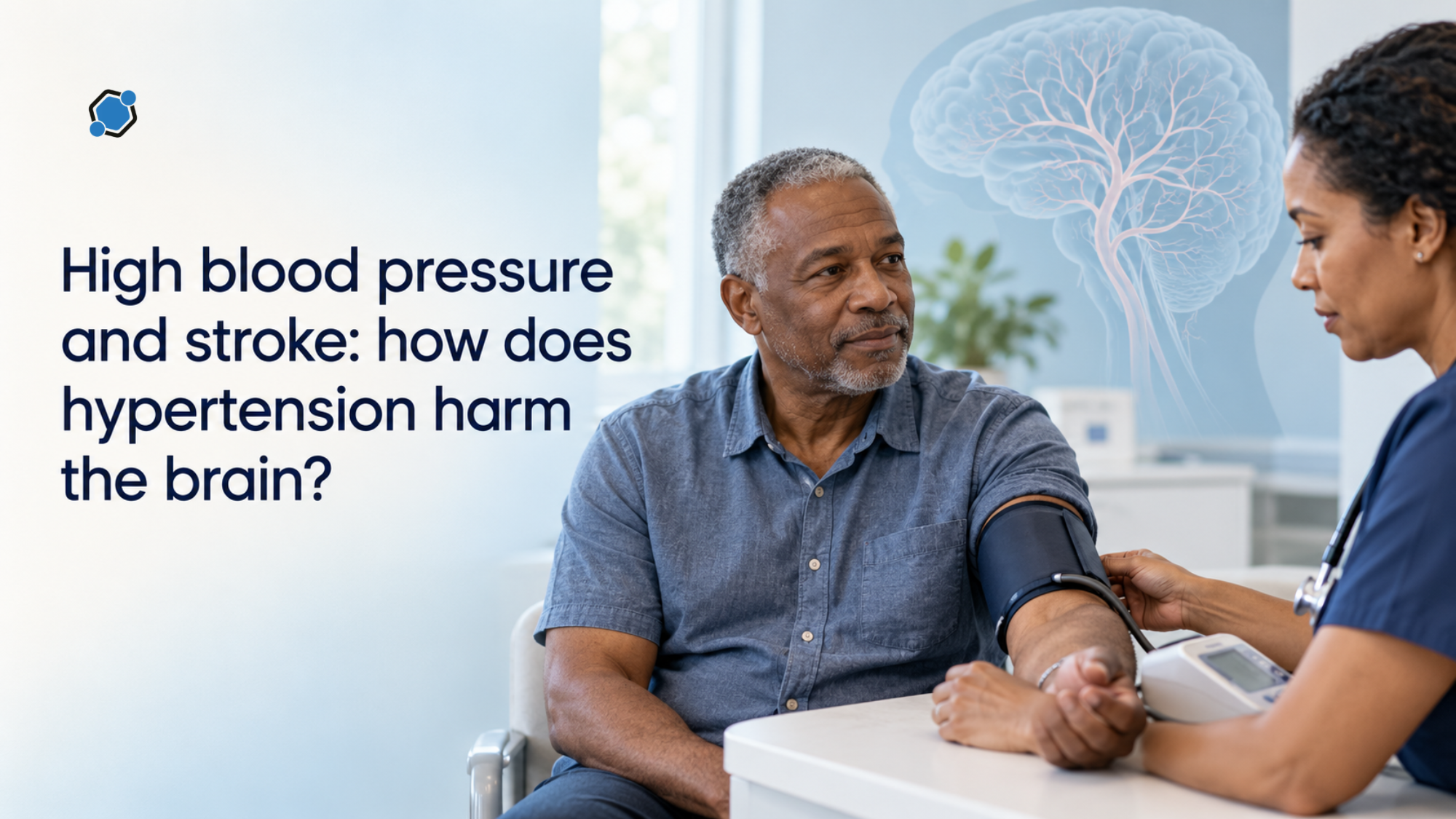
High blood pressure is the leading stroke risk factor that people can change. Over years, extra force inside the arteries wears down the blood vessels that supply the brain. That damage can lead to a blocked artery or a burst blood vessel, the two main ways a stroke happens. Because high blood pressure rarely causes symptoms, many adults live with this damage for years without knowing it. Knowing how this works shows why regular blood pressure checks matter so much.
What high blood pressure does to the arteries
Blood pressure is the force of blood pushing on artery walls as the heart pumps. It is written as two numbers, such as 118/76. The top number, called systolic pressure, measures the force when the heart beats. The bottom number, called diastolic pressure, measures the force when the heart rests between beats. Both are measured in millimeters of mercury, written as mm Hg.
Healthy arteries are smooth inside and flexible enough to stretch with each heartbeat. When pressure stays high, they are stretched beyond their healthy limit again and again, and small tears can form in the thin inner lining. The body repairs these tears with scar tissue, but the scarred areas tend to trap fat, cholesterol, and other material.
Over time, this constant strain leads to three main changes:
- Arteries become stiff and less able to cushion each heartbeat.
- Fatty deposits called plaque build up and narrow the inside of larger arteries.
- The walls of very small arteries thicken in some places and weaken in others.
None of these changes causes pain or obvious warning signs, which is why many people learn they have high blood pressure only after a routine check or a serious health event. The reasons high blood pressure rarely causes noticeable symptoms show why screening, rather than waiting for warning signs, is the only reliable way to find it.
How high blood pressure leads to each type of stroke
A stroke happens when part of the brain suddenly loses its blood supply or when blood leaks into or around the brain, and brain cells begin to die within minutes. High blood pressure raises the risk of both main types of stroke, and it does so through several different pathways.
Ischemic stroke: when an artery becomes blocked
Most strokes are ischemic strokes, which means a blood vessel that supplies the brain becomes blocked. High blood pressure speeds up plaque buildup, a process called atherosclerosis, or hardening of the arteries. Plaque can narrow the large arteries in the neck that carry blood to the brain. A clot can form on the rough plaque and block the artery, or a piece can break off and travel into a smaller brain artery.
Hemorrhagic stroke: when a blood vessel bursts
A hemorrhagic stroke happens when a weakened blood vessel breaks open and bleeds. The most common form is bleeding inside the brain tissue itself. Years of high pressure can weaken the walls of small arteries deep in the brain until one tears. This type of stroke has an especially strong link to high blood pressure. High blood pressure also raises the chance that an aneurysm, a weak and bulging spot in an artery wall, will burst and bleed around the brain.
Strokes that start in the heart
Years of pumping against high pressure can thicken the heart muscle and stretch its upper chambers. These changes raise the chance of atrial fibrillation, an irregular heart rhythm. Blood can then pool inside the heart and form clots that may travel to the brain. Atrial fibrillation raises stroke risk several times over, especially in older adults.
Small vessel damage, silent strokes, and brain health
Some of the most important effects of high blood pressure happen in the brain's tiniest arteries. The deep parts of the brain are fed by very small arteries that branch directly off much larger ones, so they take the full force of each pressure surge. Long-term high blood pressure makes the walls of these small vessels thicken and scar, which narrows the space for blood to flow.
When one of these small arteries closes, it can cause a lacunar stroke. These make up roughly one in four ischemic strokes, and high blood pressure is the most common factor in people who have them.
Many of these small strokes cause no noticeable symptoms at all. These silent strokes are often found only by chance on a brain scan done for another reason, and they are far more common than strokes that cause symptoms. Learning about silent strokes and their long-term effects helps explain why this hidden damage still matters.
Over time, this small vessel damage can add up. Researchers link it to slower thinking, memory problems, balance changes, and a higher risk of vascular dementia, which is memory loss caused by poor blood flow to the brain. Current U.S. guidelines recommend keeping the top number below 130 mm Hg partly to help protect memory and thinking skills, not only to lower stroke risk.
Which blood pressure numbers raise stroke risk
Stroke risk rises steadily as blood pressure climbs. Large studies show no single safe point. Risk goes up step by step from readings as low as about 115/75 mm Hg. In middle-aged adults, research has linked each 20-point rise in the top number to roughly double the risk of dying from a stroke.
Current U.S. guidelines, updated in 2025, kept the same blood pressure categories used since 2017:
- Normal: top number below 120 and bottom number below 80
- Elevated: top number from 120 to 129 and bottom number below 80
- Stage 1 high blood pressure: top number from 130 to 139 or bottom number from 80 to 89
- Stage 2 high blood pressure: top number of 140 or higher or bottom number of 90 or higher
- Severe high blood pressure: top number above 180 or bottom number above 120
When the two numbers fall into different categories, the higher category applies. A reading of 128/84, for example, counts as stage 1 because of the bottom number. A closer look at what each blood pressure number means can help with reading results correctly.
A reading above 180/120 mm Hg with symptoms such as chest pain, shortness of breath, numbness, weakness, vision changes, or trouble speaking is an emergency that calls for 911. A reading that high without symptoms still calls for a prompt call to a health care professional.
Why lowering blood pressure matters
The connection works in both directions. Large reviews of clinical trials show that lowering high blood pressure is linked to clearly fewer strokes, and even drops of a few points appear to help. Results differ from person to person, and no approach can guarantee that a stroke will not happen.
Approaches that current guidelines support include:
- Reaching or keeping a healthy weight
- Eating plenty of vegetables, fruits, whole grains, and low-fat dairy
- Eating less sodium and getting more potassium from food
- Staying physically active on a regular basis
- Limiting alcohol or avoiding it
- Not smoking, getting enough sleep, and managing stress
Many people also need prescription medicine. Decisions about starting medicine, choosing a type, and setting a target belong with a health care professional. Taking medicine as prescribed, and talking with a clinician before stopping it, helps keep blood pressure under control.
Checking blood pressure at home
Home readings with a validated upper-arm cuff give a fuller picture than an occasional clinic reading. Readings are most accurate after five minutes of quiet rest, while seated with the back supported, feet flat, and the arm resting at heart level. Smartwatches and other cuffless devices have not yet shown consistent accuracy. Adults with normal readings are generally advised to have blood pressure checked at least once a year, and more often if a clinician recommends it.
Recognizing a stroke and when to call 911
Quick action during a stroke can make a large difference in recovery, because many stroke treatments work only within a short window after symptoms begin. The BE FAST memory aid helps people recognize the most common signs:
- B is for Balance: sudden loss of balance or coordination, or dizziness
- E is for Eyes: sudden blurred vision, double vision, or loss of sight
- F is for Face: one side of the face droops or feels numb
- A is for Arms: one arm is weak or numb, or drifts downward when both arms are raised
- S is for Speech: speech is slurred, strange, or hard to understand
- T is for Time: call 911 right away and note the time symptoms started
Other sudden signs include confusion and a severe headache with no known cause. A call to 911 is the right step even if symptoms go away, because a brief episode can warn of a larger stroke. An ambulance is safer than driving, since emergency teams can begin care on the way. Knowing how FAST and BE FAST work together makes these signs easier to remember in a stressful moment.
Frequently asked questions about high blood pressure and stroke
Can high blood pressure cause a stroke?
Yes. High blood pressure is the leading stroke risk factor that people can change. Over time, it damages artery walls, which can lead to blocked arteries or burst blood vessels in the brain. Global research suggests it accounts for nearly half of all stroke risk.
What blood pressure level is dangerous for stroke?
Risk rises steadily above about 115/75 mm Hg, with no single safe cutoff. High blood pressure begins at 130/80 mm Hg under current U.S. guidelines, and a reading above 180/120 mm Hg with symptoms calls for 911.
Can lowering blood pressure prevent a stroke?
Lowering high blood pressure may greatly reduce stroke risk, though no treatment can guarantee prevention. Trial evidence shows that even small drops are linked to fewer strokes. A health care professional can help set the right target and approach for each person.
Can high blood pressure cause a stroke without symptoms?
High blood pressure itself usually causes no symptoms. It can also cause silent strokes, small areas of brain damage that show up on scans but go unnoticed. Over time, these can affect memory and thinking.
Is high blood pressure the biggest risk factor for stroke?
Among risk factors people can change, high blood pressure has the largest effect. Others include lack of exercise, smoking, diet, diabetes, and atrial fibrillation. Age and family history also matter but cannot be changed.
Protecting the brain starts with knowing the numbers
High blood pressure harms the brain slowly and quietly, which is why it so often goes unnoticed until a stroke occurs. That same slow process also creates time to act. Regular checks, healthy habits, and care guided by a health care professional may help lower stroke risk over the years.
Research continues to look for better ways to control blood pressure, especially when readings stay high despite several medicines. Newer options include medicines that lower a hormone that makes the body hold on to salt, shots given only a few times a year, and procedures that calm overactive nerves near the kidneys. Some are already available for certain patients, while others remain in clinical trials.
For adults interested in research, DecenTrialz is a clinical trial recruitment platform that helps connect people with relevant studies. A person shares some health information, AI-assisted matching identifies studies that may fit, and a registered nurse reviews the information before a referral goes to a research site. The research site team makes the final eligibility decision, leads the informed consent process, and handles enrollment. DecenTrialz does not provide medical advice or treatment and cannot guarantee a place in any study.
Above all, any sudden sign of stroke calls for 911 right away, even if the symptoms fade.
Was this article helpful?

Similar Blogs
Who pays for clinical trial costs, from travel to medical care?
Clinical trial costs fall into more than one category, and each category is handled differ...
 Paramraj
Mammogram vs ultrasound vs MRI: which breast test is best, and when?
...
Swaroop ESD
Obesity and joint pain: why knees, hips, and even hands feel the strain
Knee pain on the stairs, a stiff hip after a long drive, and aching finger joints in the m...
Deeksha GittaStay Informed. Stay Connected.
Get updates on verified clinical trials, emerging treatments, and research breakthroughs directly in your inbox. No spam, just science that matters.
