 HIPAA Compliant
 ISO 27001 Certified
Ischemic vs hemorrhagic stroke: what causes each and how they differ
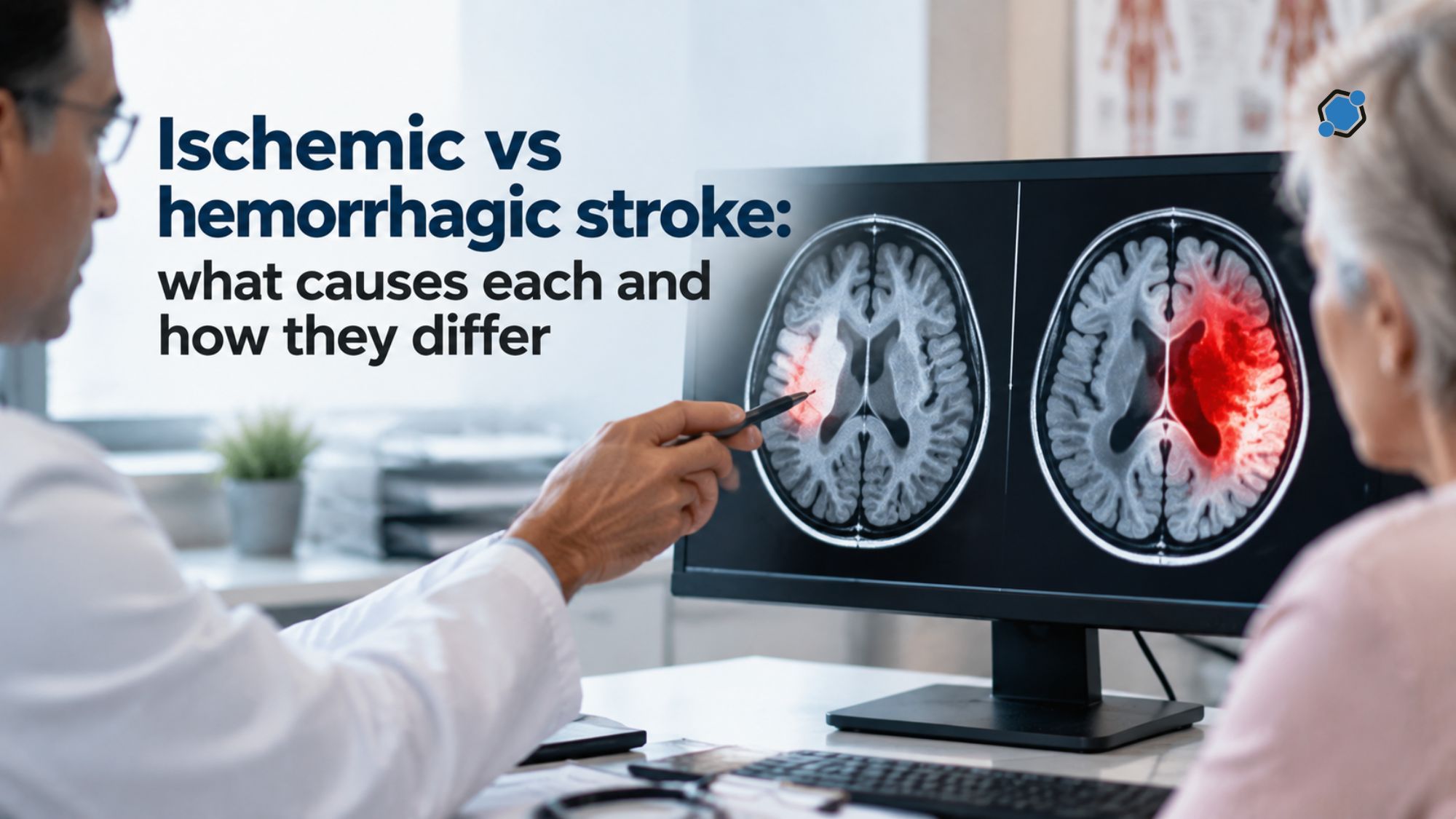
A stroke happens when blood flow to part of the brain is disrupted. There are two main kinds. An ischemic stroke happens when an artery to the brain is blocked. A hemorrhagic stroke happens when a blood vessel in or around the brain ruptures and bleeds. Ischemic vs hemorrhagic stroke is not a small technical distinction. It changes what emergency treatment can safely be given, how doctors act in the first hour, and what recovery is likely to look like.
In the United States, about 87 percent of strokes are ischemic and about 13 percent are hemorrhagic, according to the Centers for Disease Control and Prevention. Hemorrhagic strokes are less common but tend to be more dangerous in the first days. The symptoms of the two types can look almost identical at the moment they happen, which is why any suspected stroke is a reason to call 911, not a reason to wait and see.
What is an ischemic stroke
An ischemic stroke occurs when a blood vessel supplying the brain becomes blocked. When blood flow stops, brain cells in that area begin to die within minutes. The blockage is usually a clot. Sometimes the clot forms in the brain artery itself, on top of fatty buildup called atherosclerosis. In other cases, the clot forms elsewhere in the body, most often the heart, and travels through the bloodstream until it lodges in a brain artery. This kind of traveling clot is called an embolus, and the stroke it causes is called an embolic stroke.
A common source of embolic strokes is atrial fibrillation, an irregular heart rhythm in which the upper chambers of the heart do not squeeze properly. Blood can pool there and form clots. Another ischemic stroke pattern involves very small, deep arteries inside the brain. When one of these narrows and closes off, the result is a small stroke called a lacunar stroke, usually linked to long-standing high blood pressure or diabetes.
Ischemic strokes are the reason clot-dissolving medication and mechanical clot removal, called thrombectomy, exist. Because ischemic stroke damages a specific area of brain tissue, the goals of emergency care are to reopen the blocked artery quickly and protect surrounding tissue that has not yet died. That is why stroke care is connected to broader brain health and everyday prevention, which focuses on lowering the everyday risks that lead to a first stroke.
What is a hemorrhagic stroke
A hemorrhagic stroke occurs when a weakened blood vessel in the brain ruptures and bleeds. Damage happens two ways at once. First, the area of the brain that depended on that vessel loses its blood supply. Second, the blood that escapes builds pressure inside a closed space, irritates brain tissue, and often causes swelling. Both effects can injure brain cells beyond the site of the burst.
There are two main kinds of hemorrhagic stroke. Intracerebral hemorrhage is bleeding directly into brain tissue, and it is the more common of the two. Long-standing high blood pressure is the most frequent cause, followed by conditions that weaken blood vessel walls with age, use of blood-thinning medication, and abnormal tangles of vessels called arteriovenous malformations. Subarachnoid hemorrhage is bleeding into the thin space between the brain and its outer covering, most often from the rupture of a brain aneurysm, which is a balloon-like weak spot in an artery wall.
A sudden, very severe headache is a hallmark of subarachnoid hemorrhage. People often describe it as the worst headache of their life. Subarachnoid hemorrhage is also more common in women than in men, which is one reason it is worth learning the signs of stroke in women, including warning signs that do not always match the classic textbook picture.
Key differences between ischemic and hemorrhagic stroke
The two types of stroke share the same emergency footprint, but the underlying problem is opposite. One is a blocked vessel. The other is a burst vessel. Several practical differences flow from that.
Cause. Ischemic stroke is typically caused by a clot or narrowing of a blood vessel due to atherosclerosis. Hemorrhagic stroke is typically caused by a ruptured vessel, most often because chronic high blood pressure has weakened it over time.
Frequency. Ischemic strokes are far more common in the United States, at roughly 87 percent of all strokes. Hemorrhagic strokes account for about 13 percent.
Severity in the first days. Hemorrhagic strokes tend to be more dangerous early on. Bleeding can expand in the first hours, pressure inside the skull can rise, and both intracerebral hemorrhage and ruptured aneurysm carry higher short-term mortality than most ischemic strokes.
Emergency treatment. This is the critical difference. Clot-dissolving medication and mechanical thrombectomy are used for ischemic stroke. In a hemorrhagic stroke, those same clot-dissolving drugs would make the bleeding worse. That is why brain imaging comes before treatment, always.
Long-term risk factor emphasis. Both types share risk factors, but the balance is different. High blood pressure is the most powerful risk factor for both, and it is even more strongly linked to hemorrhagic stroke. Understanding the silent symptoms of high blood pressure matters because uncontrolled blood pressure often causes no obvious warning until damage has already begun.
Warning signs and why time matters
The symptoms of an ischemic stroke and a hemorrhagic stroke overlap. From the outside, one cannot reliably be told from the other. What both share are sudden neurological changes. The most widely taught warning signs are captured in the acronym FAST: Face drooping on one side, Arm weakness, Speech difficulty, and Time to call 911. A newer version, BE-FAST, adds Balance loss and Eye changes such as blurred or double vision at the front.
Other sudden warning signs include numbness on one side of the body, confusion, trouble understanding speech, and a sudden severe headache with no known cause. That last one, the thunderclap headache, is especially associated with a bleed. A detailed walkthrough of the FAST and BE FAST stroke warning signs covers how to check for each sign quickly and what to do next.
Time is the reason speed matters. Brain tissue is lost quickly during a stroke. Research published in the journal Stroke estimated that in a typical large-vessel ischemic stroke, roughly 1.9 million neurons are lost every minute the artery stays blocked. For hemorrhagic stroke, early control of blood pressure and, in some cases, reversal of blood-thinning medication also work best when started quickly. In both cases, calling 911 is faster than driving to a hospital because emergency medical teams begin assessment on the way and route the patient to a stroke-ready facility.
Why the difference matters for treatment and research
Once someone arrives at the hospital with stroke symptoms, the first job is to figure out which kind of stroke it is. A noncontrast CT scan of the head is the standard first test because it is fast and reliable for spotting bleeding. If the scan shows no bleeding, doctors move on to further imaging and, if eligible, deliver clot-dissolving medication. For eligible patients with a large-vessel blockage, mechanical thrombectomy may follow. If the scan does show bleeding, the team focuses on controlling blood pressure, reversing any blood thinner in the system, managing swelling, and considering surgical options for certain kinds of bleeds.
Stroke research is moving quickly in both directions. On the ischemic side, updated guidance from the American Heart Association and American Stroke Association has extended treatment windows for some patients and endorsed newer clot-dissolving options. On the hemorrhagic side, studies of early intensive blood pressure management and minimally invasive surgery to remove blood clots inside the brain are changing what care looks like. Understanding blood pressure numbers is part of that story, because blood pressure control is one of the most studied and consequential parts of both stroke prevention and stroke recovery.
Clinical trials are how these treatments got to patients in the first place. Every clot-busting drug, every thrombectomy device, and every improvement in stroke rehabilitation was tested in people who chose to participate in research. DecenTrialz is a clinical trial recruitment and pre-screening platform where individuals interested in participating can share basic information, get matched to studies through AI-assisted matching, and speak with a registered nurse who conducts pre-screening. Final eligibility determination, informed consent, the study walk-through, and enrollment remain with the authorized research site and study team. For anyone curious about stroke-related research, decentrialz.com is a starting point to see what is currently recruiting.
Frequently asked questions
Which type of stroke is more common?
Ischemic stroke is far more common. About 87 percent of strokes in the United States are ischemic, and about 13 percent are hemorrhagic, according to the Centers for Disease Control and Prevention.
Which type of stroke is more dangerous?
Hemorrhagic strokes tend to have higher mortality in the first days and weeks. However, any stroke can be life-threatening or cause lasting disability. Outcome depends on the size and location of the stroke, the person's overall health, and how quickly treatment begins.
Can a person tell which type of stroke they are having from the symptoms?
No. The symptoms overlap too much to be sure. A sudden, very severe headache raises suspicion for a bleed, but only a brain scan can confirm the type. That is why emergency care and imaging come first.
Why can doctors not give a clot-busting drug right away?
Because if the stroke is caused by a bleed, a clot-dissolving drug could make the bleeding worse. A CT scan of the head is done first to rule out hemorrhage before those medications are considered.
Can a stroke happen to younger adults?
Yes. Stroke risk rises sharply with age, but strokes can and do happen at younger ages. Certain risk factors and conditions, including some pregnancy-related conditions, arteriovenous malformations, and drug use, can cause stroke in younger adults.
Are strokes preventable?
Many are. Controlling blood pressure, treating atrial fibrillation, managing diabetes and cholesterol, avoiding tobacco, staying physically active, eating well, and limiting alcohol all lower stroke risk. These are the same steps that lower risk for both ischemic and hemorrhagic stroke, though blood pressure control matters most for hemorrhagic risk.
The bottom line on ischemic vs hemorrhagic stroke
Ischemic and hemorrhagic strokes look similar in the moment but are opposite problems inside the brain. One is a blocked artery. The other is a burst artery. That difference decides which treatments can be safely used, which is why every suspected stroke needs a brain scan before treatment, and why every suspected stroke needs a call to 911, not a decision to wait.
Research continues to change what is possible in stroke care. Treatment windows have grown, imaging has improved, and surgical options for certain brain bleeds are being studied more carefully than ever. Clinical trials are the engine behind that progress. Anyone interested in exploring stroke-related studies can visit decentrialz.com to share basic information and be matched to research that may be a fit, with a registered nurse conducting pre-screening before a referral goes to the research site team.
Was this article helpful?

Similar Blogs
World Mental Health Day 2026 and the push for lived experience
World Mental Health Day falls on Saturday, October 10, 2026, and this year’s theme marks a...
 Anish Teepireddy
Eczema Awareness Month 2026: Signs, triggers, and why research matters
October is Eczema Awareness Month in the United States, led by the National Eczema Associa...
 Paramraj
Liver Awareness Month 2026: Liver Disease, Liver Cancer, and the Research Changing Outcomes
Every October, two overlapping observances turn attention to an organ most people rarely t...
Vamshi KantojuStay Informed. Stay Connected.
Get updates on verified clinical trials, emerging treatments, and research breakthroughs directly in your inbox. No spam, just science that matters.
