 HIPAA Compliant
 ISO 27001 Certified
Mental Illness Awareness Week 2026: facts, stigma, and the science changing mental health care
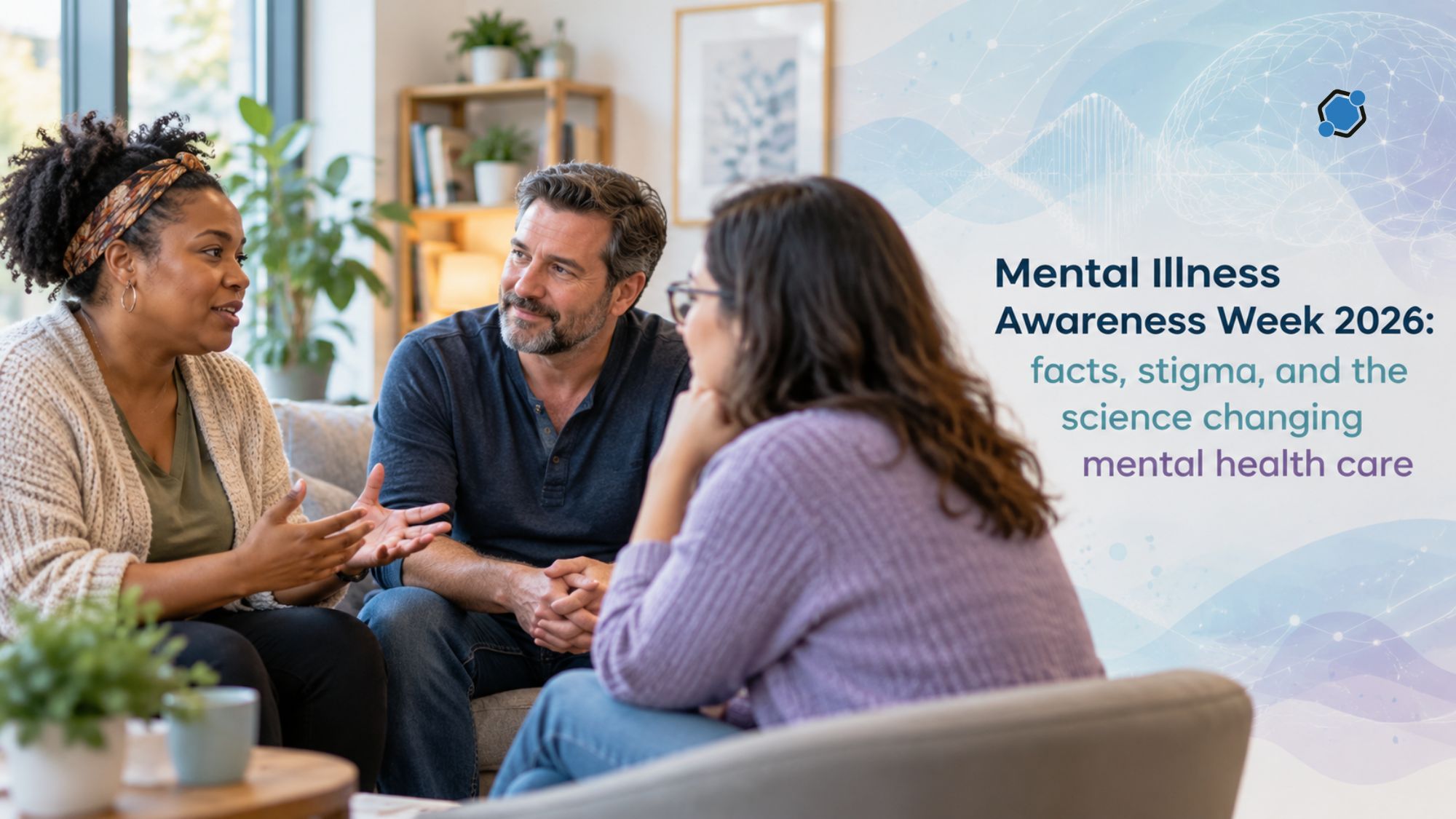
Mental Illness Awareness Week runs from October 4 to October 10, 2026. Established by Congress in 1990 after advocacy by the National Alliance on Mental Illness (NAMI), the week asks the public to look honestly at how common mental illness is, how often treatment is missed, and what new research is making possible. The 2026 theme, "Turning Science Into Hope," points to a decade of real progress and the long road still ahead to make that progress reach everyone.
For a general audience, the most useful way to mark the week is to understand four things: what mental illness looks like in the United States today, why so many people still do not get care, how research is changing the options available, and where to go for help.
What is Mental Illness Awareness Week?
Mental Illness Awareness Week, often shortened to MIAW, is an annual public health observance organized by NAMI and recognized by Congress since 1990. It falls on the first full week of October, which places the 2026 observance on October 4 through October 10.
Two closely linked days sit inside the same week. National Depression Screening Day falls on Thursday, October 8, with free and anonymous screenings available through Mental Health America. World Mental Health Day, founded by the World Federation for Mental Health in 1992, closes the week on October 10. Its 2026 theme is "Lived Experiences Heard: Real Voices, Real Change."
Both themes this year place lived experience at the center. Every medicine, device, and therapy that currently helps someone with a mental health condition was shaped by people who took part in research. Another October observance worth knowing about is ADHD Awareness Month, which overlaps with many of the same issues around diagnosis, access, and stigma.
How common is mental illness in the United States?
The most recent federal data come from the 2025 National Survey on Drug Use and Health, released by the Substance Abuse and Mental Health Services Administration (SAMHSA) in July 2026. The survey estimates that 20.6 percent of U.S. adults, about 54.6 million people, had any mental illness in the past year. Serious mental illness, meaning a condition that substantially interferes with daily life, affected 6.9 percent of adults, or about 18.2 million people.
Mental illness is not one condition. The term covers a wide range of diagnoses, from common conditions such as major depressive disorder and generalized anxiety disorder to less common but serious conditions such as schizophrenia and bipolar disorder. Depression alone affected an estimated 8.2 percent of U.S. adults in 2024, with rates almost twice as high among adults aged 18 to 25.
A note on the numbers: SAMHSA updated the way it predicts mental illness in the 2025 survey, so these figures should not be directly compared with earlier years. The survey also only reaches people living in households, which means people experiencing homelessness, people in jails, and people in psychiatric institutions are not counted. The real burden of serious mental illness is likely higher. For broader context on how the brain changes across life, brain health across the lifespan is a useful starting point.
The treatment gap: why half of adults with mental illness do not get care
About half of U.S. adults with a mental illness in 2025 received any treatment. That means roughly 27 million people with a diagnosed or diagnosable condition went through the year without care. Among adults with serious mental illness, the treatment rate was higher at about 68 percent, which still leaves nearly a third without professional support.
NAMI estimates an average delay of 11 years between the first signs of a mental health condition and the start of treatment. During those years, symptoms can worsen, relationships can suffer, and the risk of co-occurring issues such as substance use rises. In 2025, more than 40 percent of adults with any mental illness also had a substance use disorder.
Several barriers explain the gap:
- Cost and insurance coverage. A majority of adults with unmet mental health needs cite affordability as a reason they did not seek care.
- Shortages of providers. Many communities, especially rural ones, do not have enough psychiatrists, psychologists, or licensed counselors to meet demand.
- Not knowing where to start. Nearly half of adults with unmet needs say they did not know how to find care.
- Stigma and self-reliance. Fear of judgment and the belief that one should handle it alone are among the most consistent reasons people give for staying silent.
The gap is not evenly distributed. Among adults with any mental illness in 2024, treatment was received by about 58 percent of White adults, 44 percent of Hispanic adults, 39 percent of Black adults, and 33 percent of Asian adults. Men were treated at 42 percent compared with 59 percent of women. These disparities reflect a mix of insurance coverage, provider access, cultural factors, and representation of these communities within mental health care itself.
Stigma, in 2026, still shapes who gets help
Public attitudes toward mental illness have shifted meaningfully in the past two decades. More people talk about therapy openly, workplaces have begun offering mental health benefits, and public figures speak about their diagnoses in ways that would have been uncommon a generation ago. Yet stigma remains the single most consistent barrier to help-seeking.
A 2025 NAMI workplace poll of full-time employees found that nearly half worried they would be judged if they shared their own mental health struggles at work. The top reasons for staying silent were stigma, the sense that colleagues do not discuss the topic, fear of appearing weak, and concern about retaliation.
Three persistent myths are worth naming directly:
- "Mental illness is rare." In 2025, roughly one in five adults in the United States lived with a mental health condition in the past year.
- "Treatment does not really work." More than two-thirds of adults with serious mental illness received treatment in 2025, and modern therapies, medications, and brain stimulation approaches can produce meaningful improvement.
- "It is a sign of personal weakness." Mental illnesses are health conditions with biological, psychological, and social contributors.
How research is changing the options for mental health care
The 2026 theme has a basis in recent regulatory and scientific milestones. Between 2025 and 2026, the U.S. Food and Drug Administration (FDA) approved several first-of-their-kind treatments for mental health conditions:
- An esketamine nasal spray was approved as the first stand-alone treatment for adults with treatment-resistant depression, meaning depression that has not responded to at least two standard antidepressants.
- A new at-home brain stimulation device for moderate to severe depression received FDA approval in late 2025, the first non-drug home treatment of its kind.
- A new antipsychotic medication was approved in early 2026 for schizophrenia and for certain phases of bipolar I disorder.
- Deep transcranial magnetic stimulation, a non-invasive brain stimulation therapy, had its label expanded to adolescents aged 15 to 21 with major depressive disorder, as an add-on to standard treatment.
Beyond approved treatments, researchers are studying psychedelic-assisted therapies, digital therapeutics (software-based treatments delivered through apps or devices), new classes of antidepressants, and biomarkers that could one day help match a person to the right treatment faster.
None of these treatments reached patients without clinical trials. A clinical trial is a research study in which volunteers help scientists test whether a treatment is safe and whether it works, and for whom it works best. Participation is voluntary, participants can leave at any time, and all trials are reviewed by independent ethics boards before they begin.
One stubborn problem the research community is still working on is diversity in trial populations. When trial participants do not reflect the people who will eventually use a treatment, it is harder to know whether findings apply equally across groups. Awareness months such as National Minority Donor Awareness Month make the same point in other parts of medicine.
How to take part during Mental Illness Awareness Week
Observing the week does not require a special event. The actions below are concrete and can fit into a normal week:
- Learn and share accurate information. Follow NAMI and other reputable mental health organizations, and avoid content that sensationalizes mental illness or presents outcomes as guaranteed.
- Take a free screening. Mental Health America hosts free, anonymous online screenings, which are especially promoted on National Depression Screening Day.
- Check in on someone. A direct, brief message to someone you have been worried about can open a door that stigma usually keeps shut.
- Look into local NAMI programs. NAMI offers free peer-led education programs, local support groups, and NAMIWalks events across the country.
- Learn how research fits in. Services such as clinical trial matching can help people compare research options relevant to their condition without searching public registries one condition at a time.
Crisis and support resources
- 988 Suicide and Crisis Lifeline: Call or text 988, or chat online, 24 hours a day, 7 days a week.
- NAMI HelpLine: Call 1-800-950-NAMI (6264), text "NAMI" to 62640, or email, Monday through Friday, 10 a.m. to 10 p.m. Eastern Time. Service is available in Spanish.
- SAMHSA National Helpline: 1-800-662-HELP (4357), free, confidential, 24 hours a day, in English and Spanish.
- Veterans Crisis Line: Dial 988, then press 1.
- Emergency: Call 911 for immediate danger.
Where DecenTrialz fits in
DecenTrialz is a U.S.-based clinical trial recruitment, pre-screening, and participant management platform. It uses AI-assisted participant matching combined with registered-nurse-led pre-screening to help people who may be interested in a clinical trial understand their options and connect with research teams. A person shares some information, the platform suggests possibly relevant studies, and a nurse reviews that information before any referral is made to a research site.
Final eligibility, informed consent, the full study walk-through, and enrollment are always handled by the research site team running the trial. For anyone exploring whether a mental health research study might be a fit, exploring trials across many conditions in one place can be a less overwhelming way to begin than navigating several condition-specific sites.
Frequently asked questions about Mental Illness Awareness Week
When is Mental Illness Awareness Week in 2026?
Mental Illness Awareness Week in 2026 runs from Sunday, October 4 through Saturday, October 10. It falls on the first full week of October every year.
Who started Mental Illness Awareness Week?
NAMI (the National Alliance on Mental Illness) started the week in 1990 through advocacy with the U.S. Congress.
What is the 2026 theme?
The 2026 theme is "Turning Science Into Hope." It highlights the role of scientific progress, shaped by the lived experiences of people with mental health conditions.
What is the quickest way to get help in a mental health crisis?
Call or text 988 to reach the Suicide and Crisis Lifeline, available 24 hours a day, 7 days a week. In the event of immediate danger, call 911.
Why this week continues to matter
Mental Illness Awareness Week is not a solution to the United States mental health challenge. One week cannot close an 11-year gap between symptoms and treatment, remove the stigma that keeps nearly half of workers silent, or guarantee that the next generation of therapies will reach every community equally. What it can do, and does well, is give the public a yearly moment to look clearly at the numbers, recognize how much progress has come from research, and make the next conversation about mental health a little easier than the last one.
Was this article helpful?

Similar Blogs
National Depression and Mental Health Screening Month 2026: what it is and why it matters
Each October, health organizations across the United States observe National Depression an...
 Anish Teepireddy
ADHD Awareness Month 2026: adult diagnosis, the gap in women, and research shaping better care
Millions of adults in the United States are being recognized with Attention-Deficit/Hypera...
 Swaroop ESD
Breast Cancer Awareness Month 2026: Signs, Types, and Why Research Still Matters
Before the ribbon was pink, it was peach. In the early 1990s, a grandmother in California ...
ParamrajStay Informed. Stay Connected.
Get updates on verified clinical trials, emerging treatments, and research breakthroughs directly in your inbox. No spam, just science that matters.
