 HIPAA Compliant
 ISO 27001 Certified
OCD Awareness Week 2026: symptoms, myths, and the research gap
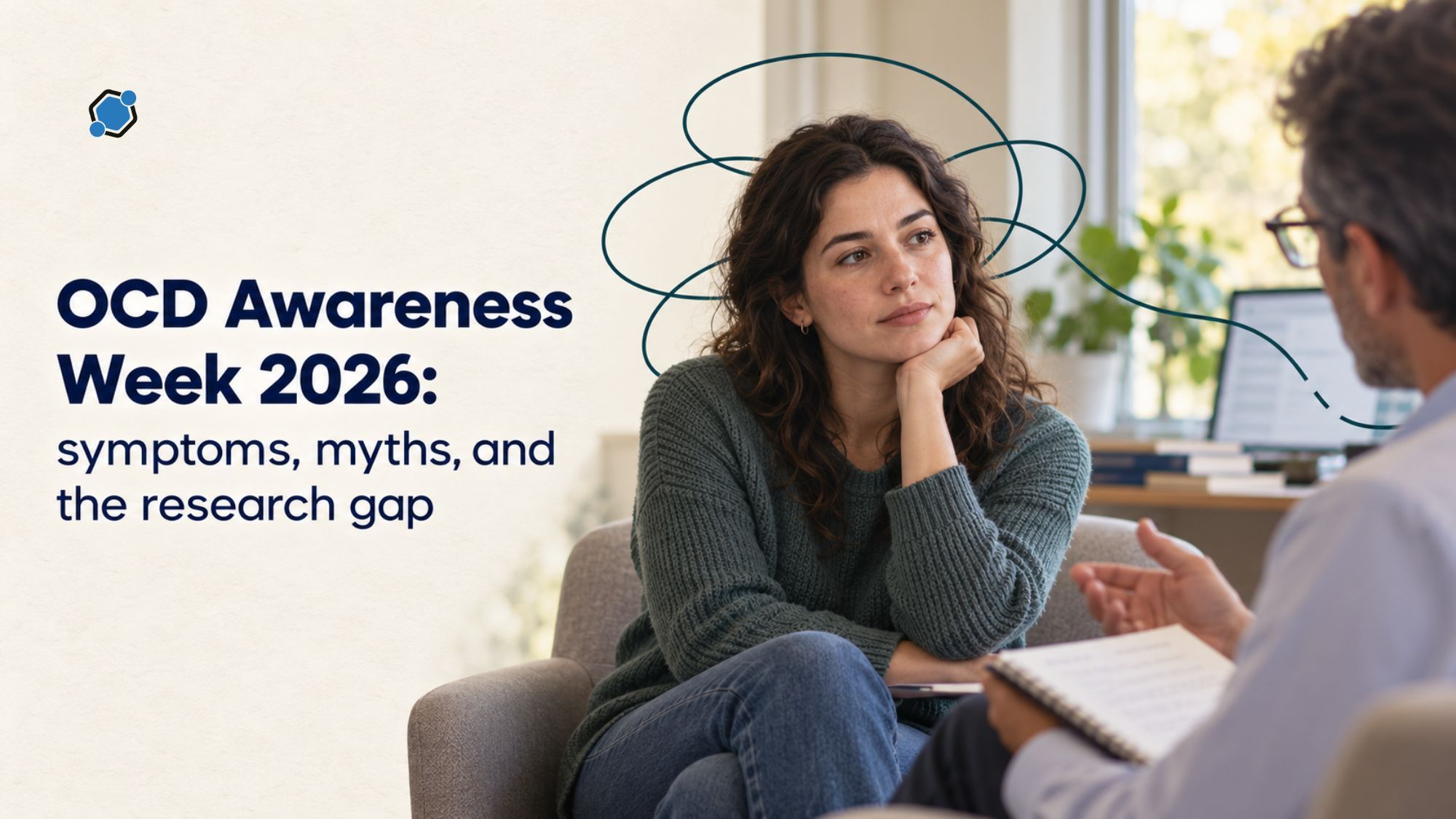
OCD Awareness Week 2026 runs October 11 through October 17 and marks the second full week of October, as it has since the International OCD Foundation launched the week in 2009. The 2026 theme, "That's OCD," draws attention to the many forms the condition takes and to how often it is misread as a personality quirk or a cleaning habit. Obsessive-compulsive disorder affects roughly 1 in 40 adults in the United States over a lifetime, yet most people with OCD are never diagnosed, and even those who are rarely receive the therapy that works best. The week exists to shrink that gap by replacing stereotypes with accurate information.
This guide explains what OCD actually is, why it is so commonly misunderstood, what treatments are available today, and why clinical research continues to matter for a condition that still leaves many people underserved.
What OCD is and how it works
Obsessive-compulsive disorder is a long-term mental health condition built around a cycle of two parts. Obsessions are unwanted, intrusive thoughts, images, or urges that cause significant distress. Compulsions are the repetitive behaviors or mental acts a person feels driven to perform in an attempt to calm that distress or prevent a feared outcome. The National Institute of Mental Health (NIMH) describes the condition as one in which these obsessions and compulsions become uncontrollable and recurring.
The cycle is self-reinforcing. An intrusive thought creates anxiety. A compulsion brings short-term relief. The brain learns that the compulsion "worked," and the next intrusive thought arrives with even more intensity. Over time, the loop tightens and begins to consume more and more of a person's day.
Clinicians diagnose OCD using criteria from the Diagnostic and Statistical Manual of Mental Disorders, Fifth Edition, Text Revision (DSM-5-TR). A key threshold in that definition is time and impact. The obsessions or compulsions must take more than an hour a day, or cause significant distress, or interfere with work, school, relationships, or daily life. That threshold is what separates OCD from everyday worry or an organized personality style.
The many forms OCD takes
The theme of OCD Awareness Week 2026, "That's OCD," was chosen because so many people with the condition say the same thing when they finally learn what it is: "I didn't know that was OCD." The disorder goes far beyond handwashing and symmetry. Common themes include:
- Contamination fears involving germs, chemicals, or bodily fluids.
- Harm obsessions, such as a fear of acting on an impulse to hurt yourself or someone you love.
- Perfectionism, symmetry, and the need for things to feel "just right."
- Unwanted sexual thoughts or images.
- Scrupulosity, which centers on religious or moral fears.
- Doubt about relationships, sexual orientation, or personal identity.
- Health obsessions, including repeated body checks for signs of illness.
- Replaying past conversations or events to search for mistakes.
Compulsions are just as varied. Many are visible, such as washing, checking locks, counting, or arranging objects. Others are entirely internal, including silent prayer, mental reviewing, counting in the head, or constantly seeking reassurance from others. These mental compulsions are the reason the informal label "Pure O" exists, used to describe OCD that appears to involve only obsessions. Clinicians, including those at the Child Mind Institute, note that this term is misleading. Compulsions are almost always present. They are simply hidden from view.
Understanding this range is central to why awareness matters. For a general introduction to how mental health conditions are being studied today, see our overview of mental health clinical trials and how they are advancing.
Why "I'm so OCD" misses the point
The casual use of "OCD" as shorthand for being tidy, particular, or organized is one of the most persistent misconceptions about the condition. It flattens a serious mental health disorder into a personality quirk, and it makes it harder for people with real symptoms to recognize what they are experiencing.
There are a few important differences between a preference and a disorder. People with OCD cannot control their obsessions or compulsions even when they clearly know these patterns are excessive. The behaviors do not bring pleasure. They bring only temporary relief, followed by the return of distress. The content of obsessions is often deeply upsetting to the person experiencing them, which is why OCD is sometimes called the "doubting disorder." An intrusive thought about harming a loved one, for example, is terrifying precisely because it clashes with the person's values. It is a fear, not an intention.
Trivialization has measurable consequences. Research suggests that when the public views OCD as less serious than other mental health conditions, people with the condition are less likely to disclose their symptoms and more likely to internalize stigma. Awareness weeks exist in part to push back on this pattern. Correcting the "so OCD" shorthand is a small but meaningful act of advocacy.
How common OCD is, and how long people wait for help
According to NIMH, 2.3 percent of US adults experience OCD at some point in their lives, and 1.2 percent live with it in a given year. Newer surveys using current diagnostic criteria produce higher estimates, closer to 3 percent globally. The International OCD Foundation (IOCDF) estimates that about 1 in 100 children also has OCD. The condition typically begins in childhood, adolescence, or early adulthood, with an average age of onset of 19.5 years.
These numbers would matter less if people were being diagnosed and treated quickly. They are not. Studies estimate that people wait anywhere from about 7 years to 17 years between the first appearance of symptoms and effective treatment. A 2026 analysis by the IOCDF of more than 10 million US patient records found that only 0.51 percent carried an OCD diagnosis, far below the expected population prevalence. The report concluded that approximately 75 percent of people with OCD in the United States are never identified. Among those who are diagnosed, more than 72 percent are never referred for cognitive behavioral therapy.
The pattern of delayed diagnosis and underrecognition is not unique to OCD. Our ADHD Awareness Month 2026 overview covers a similar story in another condition, where adults often reach a diagnosis many years later than they should.
What treatment for OCD actually looks like
Effective treatments for OCD exist, and most people who receive them see meaningful improvement. The two best-supported approaches are a specific form of therapy and a group of medications.
Exposure and response prevention therapy
Exposure and response prevention (ERP) is a structured form of cognitive behavioral therapy and is considered the first-line psychotherapy for OCD. In ERP, a trained therapist gradually guides the person to face the situations or thoughts that trigger their obsessions while refraining from the compulsion that usually follows. Over time, the brain learns that the feared outcome does not occur, and the anxiety fades on its own. NIMH notes that ERP effectively reduces compulsive behaviors, including for people who have not responded well to medication.
Medications approved for OCD
The US Food and Drug Administration (FDA) has approved several medications for OCD. These include certain selective serotonin reuptake inhibitors (SSRIs) such as fluoxetine, fluvoxamine, paroxetine, and sertraline, as well as the older tricyclic medication clomipramine. OCD often requires higher doses than depression does, and these medications can take 8 to 12 weeks to begin working. The FDA has also cleared transcranial magnetic stimulation (TMS) for adults with severe OCD who have not responded to other treatments. Deep brain stimulation remains available only under a Humanitarian Device Exemption for severe, treatment-resistant cases.
Even with these options, response is far from universal. Published meta-analyses in journals including the British Journal of Psychiatry report that 40 to 60 percent of people with OCD do not respond adequately to first-line SSRI treatment. A sizable minority remain in search of better options, which is where ongoing research becomes essential.
Why clinical research matters for OCD
Most of the medications approved for OCD have been on the market for decades. New approaches are being studied in clinical trials, including glutamate-modulating medications, rapid-acting agents such as ketamine, psychedelic-assisted therapy using psilocybin, newer forms of neuromodulation, and digitally delivered versions of exposure and response prevention. These approaches are investigational. They are being tested in controlled settings and are not yet approved as standard treatments for OCD. Early findings in some areas are encouraging, but trial sizes remain small, follow-up remains short, and larger studies are needed before any of these approaches can be widely recommended.
Research is also focused on access, not only on new drugs. Studies are testing internet-delivered therapy, group-based ERP, and tools that can match more people to appropriate care. Patients who are curious about joining a study can start by exploring how clinical trial matching services work and what to look for, which explains the differences between the services that help connect people to research.
Participation in clinical research is also an issue of representation. OCD trials have historically underrepresented people from ethnic minority communities and from lower-income regions, which limits how broadly findings can be applied. Awareness weeks are a reminder that research progress depends on who is able to take part.
How to take part in OCD Awareness Week
The International OCD Foundation organizes several ways to participate during the week. Each is open to anyone, whether or not they have personal experience with OCD.
- Join the "That's OCD" campaign by sharing a specific example of how OCD shows up in daily life, using the hashtags #ThatsOCD and #OCDWeek.
- Request a landmark lighting in teal, the color of OCD awareness, through the IOCDF's "Light It Up Teal" program.
- Attend a free livestream, webinar, or community conversation hosted during the week.
- Take or share the IOCDF's free online OCD screener, which can point someone toward professional help.
- Donate to or volunteer with mental health advocacy organizations working on OCD research and public education.
- Contact an elected official about mental health care access through the IOCDF's advocacy resources.
Participation does not require disclosure. The IOCDF emphasizes that no one is obligated to share any part of their own story. Sharing accurate information is enough.
What to do if you think OCD may be affecting you or someone you know
The first step is a conversation with a licensed mental health professional, such as a psychologist, psychiatrist, or clinical social worker who is trained in treating anxiety and obsessive-compulsive disorders. A primary care clinician can also provide a referral. During an evaluation, the clinician will ask about the specific thoughts and behaviors involved, how much time they take, and how much they interfere with daily life. The Yale-Brown Obsessive Compulsive Scale (Y-BOCS) is often used to measure severity.
For people who later consider joining a clinical trial, our guide on how to read your informed consent form explains what to look for in the paperwork before enrolling in any research study.
Anyone experiencing a mental health crisis in the United States can call or text 988, the Suicide and Crisis Lifeline, for immediate support.
Where DecenTrialz fits in
DecenTrialz is a United States-based clinical trial recruitment, pre-screening, and participant management platform. Participants share basic health information, an AI matching system identifies potentially relevant studies, a registered nurse reviews the information and conducts a pre-screening conversation, and a referral is then sent to the research site team. The research site team owns final eligibility determination, informed consent, the study walk-through, and enrollment.
For mental health conditions, including OCD, this means someone exploring research participation can be connected to studies that reflect their specific situation without having to search through many trial listings on their own. A related piece on how our platform works alongside public registries is Finding a Clinical Trial: What ClinicalTrials.gov Shows and What DecenTrialz Adds.
The week behind the message
OCD Awareness Week has existed since 2009 because misunderstanding has real costs. When OCD is dismissed as a personality quirk, people with the condition wait longer to be recognized, longer to be diagnosed, and longer to receive the treatments that have been shown to work. The 2026 theme returns to that core problem by inviting people to say plainly, "That's OCD," so that others can finally recognize what they are experiencing. Research is working to close the remaining gaps, from treatment-resistant cases to the access divide, but it depends on public understanding and on continued participation. Both are what this week is for.
Was this article helpful?

Similar Blogs

World Arthritis Day 2026: Early Signs, Types, and Why Timing Matters
World Arthritis Day is observed on October 12 every year, and in 2026 it falls on a Monday...
 Mahesh Upadrista
Ischemic vs hemorrhagic stroke: what causes each and how they differ
A stroke happens when blood flow to part of the brain is disrupted. There are two main kin...
Deeksha Gitta
World Mental Health Day 2026 and the push for lived experience
World Mental Health Day falls on Saturday, October 10, 2026, and this year’s theme marks a...
 Anish Teepireddy
Stay Informed. Stay Connected.
Get updates on verified clinical trials, emerging treatments, and research breakthroughs directly in your inbox. No spam, just science that matters.
