 HIPAA Compliant
 ISO 27001 Certified

Blood pressure and stroke risk: how much does lowering it help?
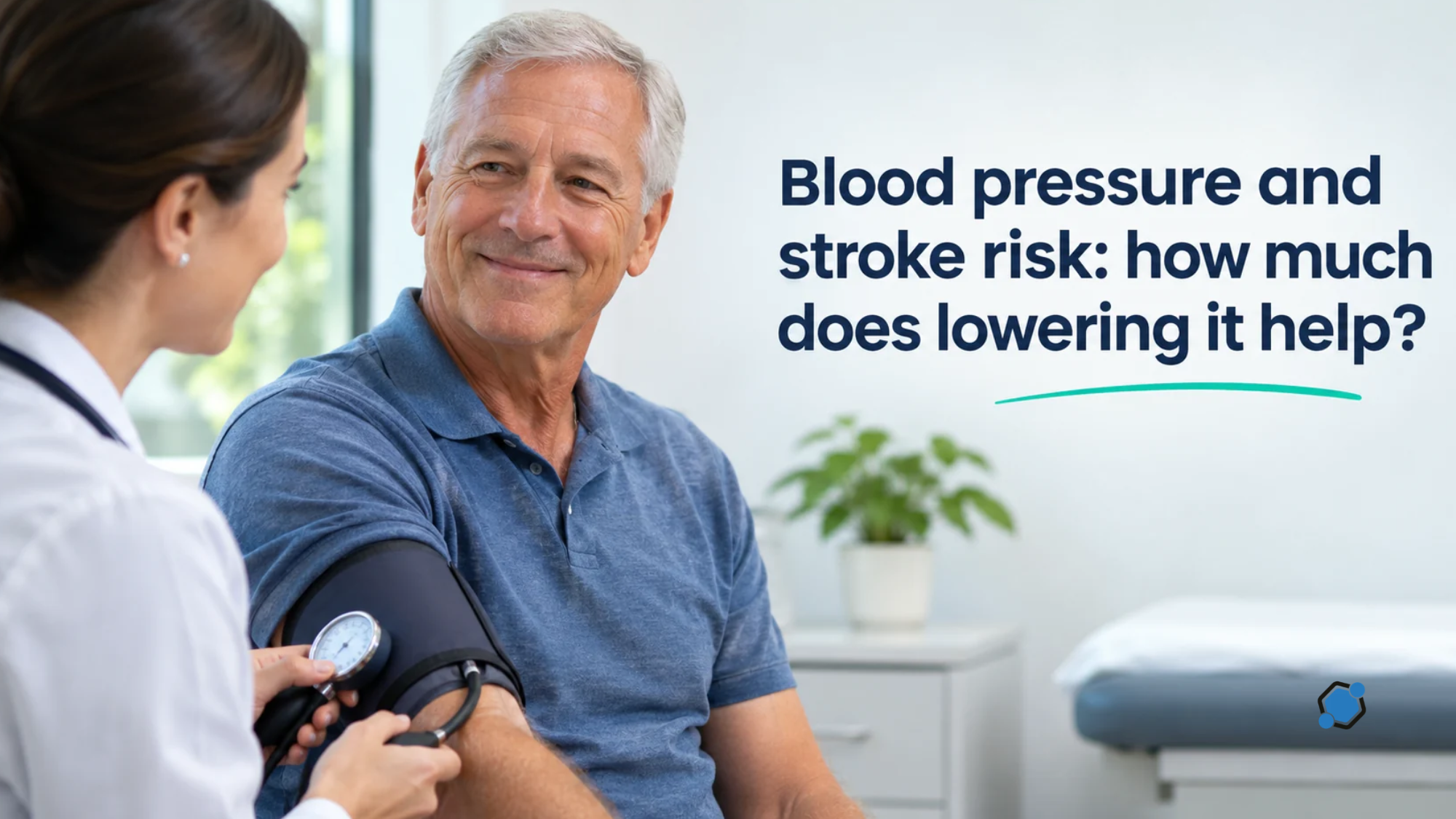
Blood pressure and stroke risk rise together, and the link starts well below the readings most people think of as high. High blood pressure is the leading stroke risk factor that people can change, and it is tied to nearly half of all stroke risk worldwide. Large studies show that stroke risk climbs step by step as pressure rises. They also show that bringing pressure down may help reduce that risk at almost any starting point.
This article explains which readings raise stroke risk, which hidden patterns matter, who faces the highest risk, and what the evidence shows about lowering blood pressure.
How are blood pressure and stroke risk connected?
Blood pressure is the force of blood pushing against the walls of the arteries. It is written as two numbers in millimeters of mercury (mmHg), a standard unit of pressure. The top number, called systolic pressure, is measured while the heart beats. The bottom number, called diastolic pressure, is measured while the heart rests between beats.
Studies that followed about a million adults found that stroke risk does not switch on at a single line. Instead, it rises steadily from readings as low as about 115/75 mmHg. In middle-aged adults, each 20-point rise in systolic pressure was linked to roughly double the risk of dying from a stroke.
Over time, high pressure strains the blood vessels that feed the brain. It speeds the buildup of fatty plaque that narrows arteries and can trigger clots. It also stiffens and weakens the tiny vessels deep in the brain until they block or burst. A closer look at how high blood pressure harms the brain shows how these changes lead to both main types of stroke.
Time matters too. A study published in late 2024 found that the more years people lived with high blood pressure, the higher their stroke risk, even when the condition was treated. This makes early detection and early control especially important.
What blood pressure level raises stroke risk?
Current U.S. guidance, updated in 2025, keeps the same four blood pressure categories that have been used since 2017:
- Normal: below 120/80 mmHg.
- Elevated: a top number of 120 to 129, with a bottom number below 80.
- Stage 1 high blood pressure: a top number of 130 to 139, or a bottom number of 80 to 89.
- Stage 2 high blood pressure: 140/90 mmHg or higher.
When the two numbers fall into different categories, the higher category applies. A reading of 128/84, for example, counts as stage 1 because the bottom number is 84. Knowing what systolic and diastolic numbers mean makes it easier to place any single reading.
Because stroke risk rises steadily, the elevated range is not a safe zone. It is an early sign that risk has already started to climb. For most adults, the 2025 guidance sets a goal below 130/80 mmHg.
Doctors usually suggest medicine along with lifestyle changes once readings reach 140/90 or higher. The threshold drops to 130/80 for people with diabetes, chronic kidney disease, past heart disease or stroke, or a high estimated risk. To estimate that risk, the 2025 guidance added a calculator for adults aged 30 to 79. It predicts the chance of a heart attack, stroke, or heart failure over the next 10 and 30 years.
Why can a normal reading in the clinic miss stroke risk?
Most people with high blood pressure feel fine. The fact that high blood pressure rarely causes symptoms is one reason it can raise stroke risk for years without notice. A single reading in a clinic also captures only one moment of the day.
Several hidden patterns have been linked to higher stroke risk:
- Large swings in readings from one visit to the next, even when the average looks acceptable.
- Nighttime high blood pressure, where pressure stays high during sleep instead of dipping as it normally should.
- Masked high blood pressure, where readings look normal in the clinic but run high at home.
- A sharp rise in pressure in the morning, a time of day when strokes are more common.
These findings show a link, not proof that each pattern directly causes stroke. They are found by checking blood pressure outside the clinic. Home checks with a validated upper-arm cuff, or a monitor worn for 24 hours, can reveal what one office visit misses.
Who faces higher stroke risk from high blood pressure?
Stroke risk tied to blood pressure is not spread evenly. Age raises it sharply, because strokes become far more common later in life. Black adults in the United States are more likely to have high blood pressure and face nearly twice the risk of a first stroke compared with White adults. Researchers link these gaps to differences in access to care and to social and economic conditions, not to individual choices alone.
Women have more strokes each year than men, partly because they tend to live longer. High blood pressure during pregnancy can also raise a woman's risk of high blood pressure and heart and blood vessel disease later in life.
Other conditions add to the risk when they appear alongside high blood pressure:
- Atrial fibrillation (AFib), an irregular heartbeat that lets blood pool and form clots in the heart. AFib raises stroke risk up to five times, and high blood pressure is one of its most common causes. A clot that travels to the brain causes the blocked-artery type of stroke described in a comparison of how ischemic and hemorrhagic strokes differ.
- Diabetes, which damages blood vessels in its own way.
- Smoking, which speeds artery damage and makes clots more likely.
- High LDL cholesterol, which feeds the plaque behind many strokes.
- Chronic kidney disease, which can result from high blood pressure and can also make it worse.
In a large study across 32 countries, a group of 10 changeable risk factors, led by high blood pressure, was linked to about 9 in 10 strokes. That finding points to how much of stroke risk may be within reach of prevention.
How much does lowering blood pressure reduce stroke risk?
Lowering blood pressure is one of the best-studied ways to help prevent stroke. A large review covering more than half a million people found that each 10-point drop in systolic pressure was linked to about a quarter fewer strokes. A later analysis found similar benefits even in people whose starting pressure was not considered high.
Results for very low targets are more mixed. Large trials that aimed for a top number near 120 found fewer heart attacks, strokes, and related deaths combined. However, the effect on stroke alone was smaller or less certain, and fainting and other side effects were somewhat more common. For this reason, the right goal is set with a clinician based on each person's health.
No treatment can guarantee that a person will avoid a stroke. Still, the 2025 guidance lists everyday steps that may help lower blood pressure:
- Limiting sodium to less than 2,300 mg a day, working toward 1,500 mg.
- Following an eating pattern rich in vegetables, fruit, whole grains, and low-fat dairy, such as the DASH diet (Dietary Approaches to Stop Hypertension).
- Staying physically active on most days of the week.
- Losing at least 5 percent of body weight for adults with overweight or obesity.
- Drinking little or no alcohol.
- Checking blood pressure at home to track progress.
Salt substitutes that swap some sodium for potassium have also been linked to fewer strokes in a large study of people with high blood pressure or a past stroke. People with kidney disease, or those who take medicines that raise potassium, should ask a doctor before using them.
Many people also need medicine. Common types include ACE inhibitors, angiotensin receptor blockers (ARBs), calcium channel blockers, and thiazide-type diuretics, and many people take more than one. When readings stay above goal despite several medicines, doctors look for the causes behind blood pressure that stays high on medication. Newer options, such as medicines that lower the hormone aldosterone and long-acting injections, are also being studied. Some are already available for certain patients, while others remain in clinical trials.
Frequently asked questions about blood pressure and stroke risk
Can high blood pressure cause a stroke without warning signs?
It can. High blood pressure usually causes no symptoms while it damages blood vessels over many years. Some people learn they have it only after a stroke or another complication. Regular blood pressure checks are the only reliable way to know.
What blood pressure reading needs urgent care?
A reading of 180/120 mmHg or higher is severe. If a reading that high comes with chest pain, shortness of breath, back pain, weakness, numbness, vision changes, or trouble speaking, call 911. If there are no symptoms, wait a few minutes, check again, and contact a doctor right away if it stays that high.
Is a stroke more likely in the morning?
Strokes are more common in the morning hours than at other times of day. This window overlaps with the natural rise in blood pressure after waking. Research has not proven that the morning rise causes these strokes, but it is one reason doctors look at readings taken at different times.
Can a smartwatch check blood pressure accurately?
Cuffless devices such as smartwatches and rings are not yet accurate enough to diagnose or manage high blood pressure. A validated upper-arm cuff remains the recommended tool for home checks.
Does stroke risk return to normal once blood pressure is controlled?
Lowering blood pressure may help reduce stroke risk, and the benefit tends to build over time. Research suggests that years spent with high blood pressure can leave some lasting risk, which is one reason early control matters. Other risk factors, such as smoking and diabetes, also need attention.
Turning blood pressure numbers into stroke prevention
Stroke risk rises with each step up in blood pressure, and it can rise quietly for years before anything feels wrong. Knowing the numbers, checking them in more than one setting, and agreeing on a target with a clinician are practical ways to act on that risk. Questions about personal readings, targets, or medicines belong with a doctor.
Much of what is known about blood pressure and stroke prevention came from clinical trials, and research continues. DecenTrialz is a clinical trial recruitment platform that helps connect people with relevant studies through AI matching, nurse-led pre-screening, and structured referrals. A person shares some health information, gets matched with studies that may fit, and a registered nurse reviews the information before any referral reaches a research site.
The research site team makes all final decisions on eligibility, informed consent, and enrollment. People with high blood pressure who are curious about research can explore hypertension studies on DecenTrialz.
Anyone who notices sudden face drooping, arm weakness, or trouble speaking should call 911 immediately, even if the symptoms go away.
Was this article helpful?

Similar Blogs
Thanksgiving health facts: what does science say about the holiday meal?
Thanksgiving comes with its own set of health beliefs. Turkey makes people sleepy, one big...
 Mahesh Upadrista
Patient-reported outcomes in clinical trials: how are your answers used?
Patient-reported outcomes in clinical trials are measurements that come directly from part...
 Anish Teepireddy
Normal blood sugar levels: what is normal when fasting and after eating?
Most people think about blood sugar only when a lab report flags a number in bold. For adu...
Deeksha GittaStay Informed. Stay Connected.
Get updates on verified clinical trials, emerging treatments, and research breakthroughs directly in your inbox. No spam, just science that matters.
