 HIPAA Compliant
 ISO 27001 Certified
National Depression and Mental Health Screening Month 2026: what it is and why it matters
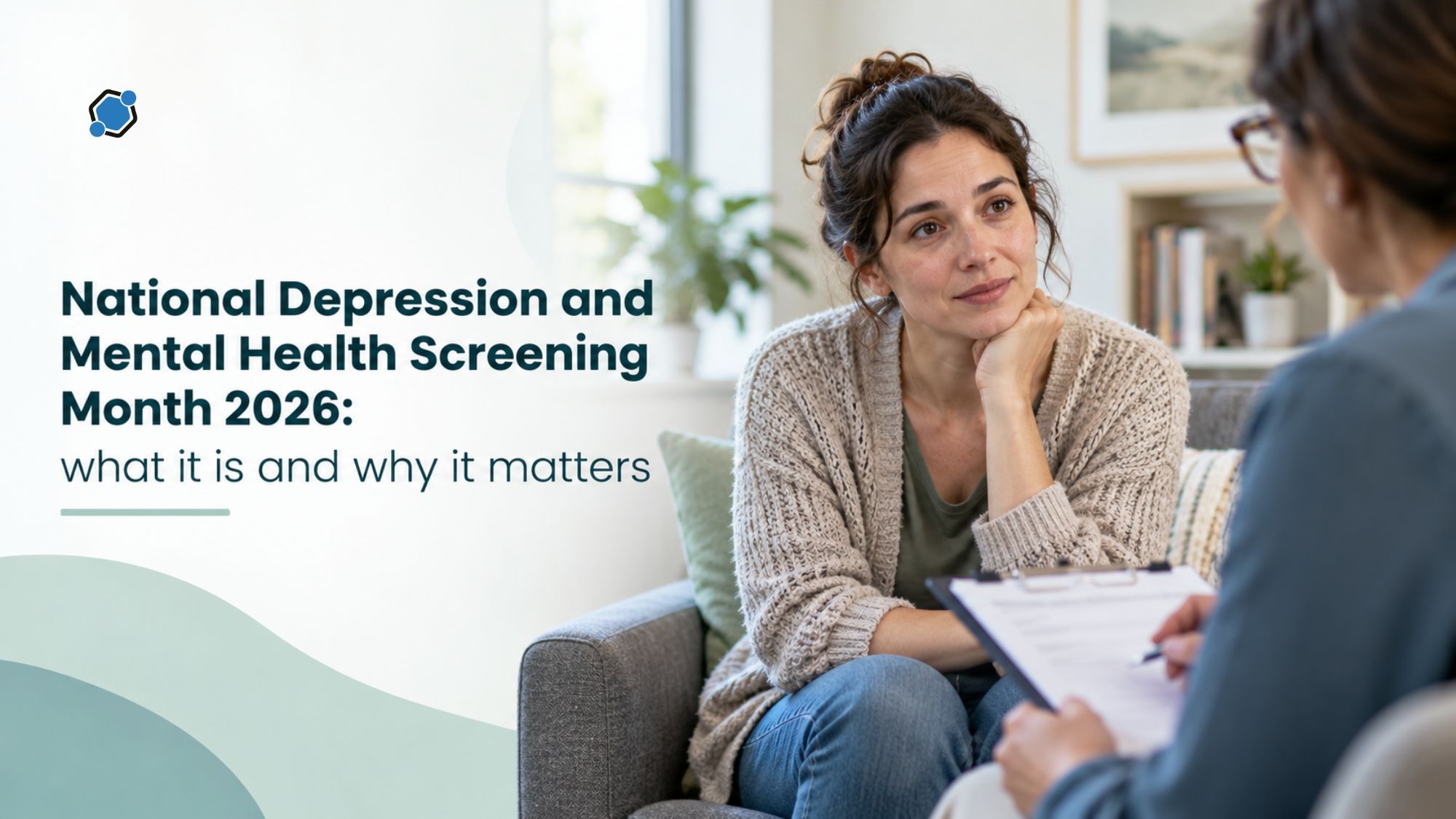
Each October, health organizations across the United States observe National Depression and Mental Health Screening Month, an awareness effort built around two long-running October events: National Depression Screening Day, first held in 1991, and Mental Illness Awareness Week, recognized by Congress since 1990. The purpose is simple. Depression and other mental health conditions are common, treatable, and often undiagnosed, and a short screening questionnaire is one of the fastest ways to find out whether a professional evaluation would help. This article explains what the month covers, what a mental health screening actually is, who should get screened, and how research continues to expand the treatment options available today.
What the October screening observance covers
October is widely referred to as National Depression and Mental Health Screening Month, but the label is informal rather than an official federal observance. Its history sits in two events that are formally recognized. National Depression Screening Day was created in 1991 by Harvard psychiatrist Dr. Douglas Jacobs, with support from the American Psychiatric Association and what is now Mental Health America, to offer free, anonymous depression screenings in community settings in the same way that blood pressure checks were already being offered. Mental Illness Awareness Week has been observed during the first full week of October since 1990, after advocacy led by the National Alliance on Mental Illness.
In 2026, Mental Illness Awareness Week runs October 4 to 10, National Depression Screening Day falls on Thursday, October 8, and World Mental Health Day, led by the World Health Organization, falls on October 10. Together, these dates give health systems, employers, schools, and community organizations a shared window to encourage self-screening, host free screening events, and connect people with care. The month complements other mental health observances throughout the year, such as Mental Health Awareness Month in May and
the June observance of PTSD Awareness Month, keeping mental health visible on the calendar beyond a single week.
Depression explained: when sadness becomes a medical condition
Sadness is a normal, temporary response to loss or disappointment. Depression is different. According to the World Health Organization, a depressive episode involves depressed mood (feeling sad, irritable, or empty) or a loss of pleasure or interest in activities, present for most of the day, nearly every day, for at least two weeks. The symptoms interfere with work, school, relationships, or daily functioning, and they are not better explained by another medical condition or by substance use.
Clinicians generally look for a combination of symptoms when evaluating depression. These include persistent low mood or irritability, loss of interest or pleasure in activities once enjoyed (sometimes called anhedonia), noticeable changes in appetite or weight, sleeping too little or too much, fatigue or low energy, difficulty concentrating or making decisions, feelings of worthlessness or excessive guilt, physical slowing or restlessness that others can observe, and recurrent thoughts of death or self-harm. A diagnosis is made by a qualified clinician based on a full assessment, not by a questionnaire alone.
Depression is also not a single condition. Major depressive disorder refers to discrete episodes of the symptoms above. Persistent depressive disorder describes a lower-grade depressed mood that lasts for two years or more. Perinatal and postpartum depression occur during pregnancy or after childbirth. Seasonal affective disorder refers to depression that recurs at a particular time of year, most often fall and winter. Bipolar disorder involves depressive episodes that alternate with periods of unusually elevated mood or energy, which matters because standard antidepressants alone may not be the right treatment. Premenstrual dysphoric disorder causes severe mood symptoms in the days before menstruation that improve once it begins. Because mental and brain health are so closely connected,
everyday steps that support brain health and prevention can also play a role in protecting mental well-being over time.
In 2024, according to the Substance Abuse and Mental Health Services Administration, an estimated 21.4 million U.S. adults (8.2 percent of adults) and 3.8 million adolescents ages 12 to 17 experienced a past-year major depressive episode. These numbers are a reminder that depression is common, that it does not reflect a personal failing, and that reaching out for an evaluation is a reasonable response to persistent symptoms.
What a mental health screening actually is
A mental health screening is a short, standardized set of questions designed to flag whether a person may be experiencing symptoms of a mental health condition and would benefit from a fuller evaluation. It is not a diagnosis. A useful comparison is a smoke detector: a positive screen signals that something may need attention, and a clinician is the one who determines whether a condition is present and what to do next.
Several short questionnaires are widely used and have been validated in research. The PHQ-9, or Patient Health Questionnaire-9, is a nine-question tool that mirrors the symptoms of depression and asks how often each has occurred over the past two weeks. The PHQ-2 is a shorter two-question version often used as a quick first pass in primary care. The GAD-7 is a seven-question tool for anxiety, which commonly occurs alongside depression. The Edinburgh Postnatal Depression Scale is designed specifically for pregnancy and the postpartum period, since fatigue and sleep changes alone are not reliable signals during that time. A positive score on any of these questionnaires is a prompt for a conversation with a qualified clinician, not a conclusion.
Who should get screened, and where to go
The U.S. Preventive Services Task Force, an independent panel of national experts that reviews preventive care, currently recommends depression screening for all adults, including pregnant and postpartum people, and for adolescents ages 12 to 18. It also recommends anxiety screening for adults ages 19 to 64 and for children and adolescents ages 8 to 18. These are Grade B recommendations, which means the panel found moderate certainty of a meaningful benefit, and most private insurance plans cover these screenings without a copay as a result. The Task Force also emphasizes that screening works best when systems are in place to follow up with accurate diagnosis, treatment, and support.
Several screening options are available. A primary care visit is one of the most common and comfortable places to be screened, since many clinicians now ask depression and anxiety questions as part of routine care. Mental Health America offers free, anonymous online screenings at mhascreening.org that are based on the same validated questionnaires used in clinics. Community health centers, college counseling centers, and local events held around National Depression Screening Day are additional options. In 2024, more than 5.9 million people took a free screening through Mental Health America, and more than half of those who scored at risk reported that they had never received mental health treatment before.
There are also moments when a screening is not the right first step. Anyone who is thinking about suicide, has made a plan, or feels unsafe should contact the 988 Suicide and Crisis Lifeline immediately by calling or texting 988, or should go to the nearest emergency department. The Lifeline is free, confidential, and available 24 hours a day. The SAMHSA National Helpline at 1-800-662-HELP (4357) offers free referrals to mental health and substance use treatment, also around the clock.
From screening to treatment to research
A positive screening is a starting point. If a clinician confirms a diagnosis, several well-established treatments are available. Talk therapies such as cognitive behavioral therapy, which helps people identify and change unhelpful thought and behavior patterns, and interpersonal therapy, which focuses on relationships and life transitions, have strong evidence for depression and anxiety. Antidepressant medications, most often selective serotonin reuptake inhibitors (SSRIs) or serotonin-norepinephrine reuptake inhibitors (SNRIs), can be helpful for moderate to severe depression and typically take several weeks to show full effect. Lifestyle supports such as regular physical activity, consistent sleep, and social connection help but do not replace treatment for moderate or severe illness.
Research continues to expand what is possible. In recent years, regulators have approved the first prescription digital therapeutic smartphone app for depression used alongside standard care, the first oral medication designed specifically for postpartum depression, and, in January 2025, the first standalone nasal spray treatment for treatment-resistant depression that is administered in certified health care settings. At the same time, several investigational therapies, including psilocybin-assisted treatment for treatment-resistant depression, are moving through late-stage clinical trials and are not yet approved by the U.S. Food and Drug Administration. Each of these developments exists because volunteers took part in research.
For readers considering clinical research as part of their care plan, it helps to know what a trial screening visit looks like, from the eligibility questions to the informed consent conversation. A short list of mental health clinical trials and how they advance care is a useful companion read for anyone new to the topic.
Taking the next step this October
National Depression and Mental Health Screening Month is less about a single day on the calendar and more about a steady reminder: a few minutes with a validated questionnaire is often the shortest distance between quiet suffering and professional support. For many people, that short step leads to therapy, medication, or a combination that genuinely improves daily life. For others, it opens the door to clinical research that is working to make tomorrow’s treatments better than today’s.
DecenTrialz is a United States clinical trial recruitment, pre-screening, and participant management platform. It combines AI-assisted matching with registered-nurse-led pre-screening to help people find clinical studies they may be a fit for. The research site team always owns final eligibility, informed consent, and enrollment decisions. For anyone exploring the option, a plain-language overview of how clinical trial matching services work is a good place to start. If a depression or mental health screening leads to a conversation with a clinician this month, that is already a meaningful step forward.
Was this article helpful?

Similar Blogs
Mental Illness Awareness Week 2026: facts, stigma, and the science changing mental health care
Mental Illness Awareness Week runs from October 4 to October 10, 2026. Established by Cong...
 Deeksha Gitta
ADHD Awareness Month 2026: adult diagnosis, the gap in women, and research shaping better care
Millions of adults in the United States are being recognized with Attention-Deficit/Hypera...
Swaroop ESD
Breast Cancer Awareness Month 2026: Signs, Types, and Why Research Still Matters
Before the ribbon was pink, it was peach. In the early 1990s, a grandmother in California ...
ParamrajStay Informed. Stay Connected.
Get updates on verified clinical trials, emerging treatments, and research breakthroughs directly in your inbox. No spam, just science that matters.
