 HIPAA Compliant
 ISO 27001 Certified

World Stroke Day 2026: What are the warning signs of stroke, and how is research changing care?
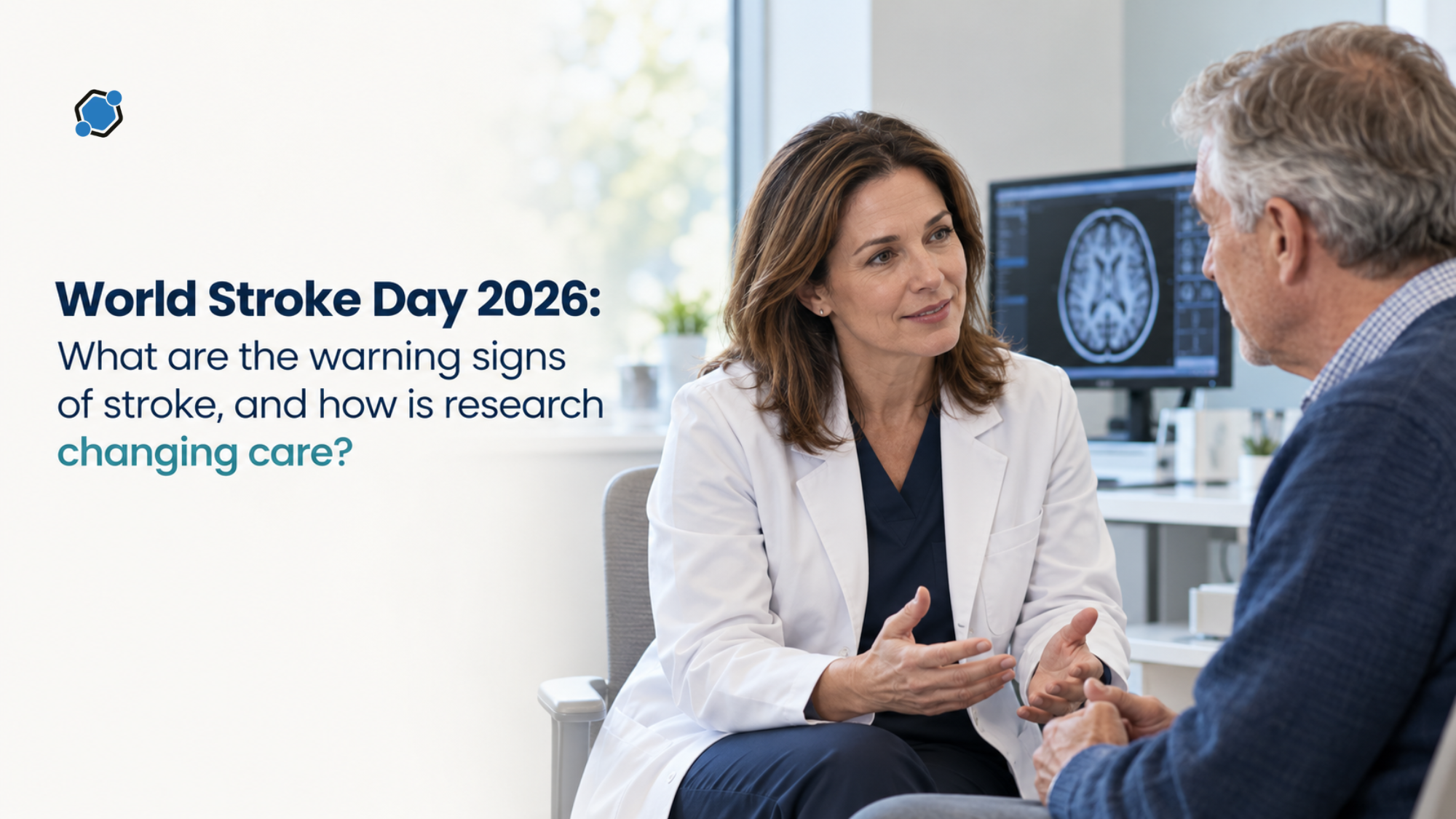
World Stroke Day 2026 falls on Thursday, October 29, and its message is direct: recognizing a stroke quickly and calling for emergency help can change how much of the brain is saved. Stroke is one of the leading causes of death and serious long-term disability worldwide, and about one in four adults will have a stroke at some point in their lives. This year’s campaign, “Every M1nute Counts,” shared under #ActFAST, centers on knowing the warning signs and acting without delay.
This article explains what World Stroke Day is, what happens during a stroke, how to recognize one, which risk factors can be managed, and how clinical research built the emergency treatments used today.
What is World Stroke Day, and what is the 2026 focus?
World Stroke Day is observed every year on October 29. It is led by an international nonprofit that brings together stroke professionals, researchers, and patient organizations, and it was formally established as an annual observance in 2006. The year 2026 marks two decades of the global awareness campaign built around the day.
The 2026 campaign, “Every M1nute Counts,” continues a two-year focus on symptom awareness and fast treatment. The stylized “1” in the name is a reminder that the first minutes after symptoms begin are often the most important. The campaign asks people to learn the signs, share them with family and friends, and call emergency services as soon as they appear.
The observance also arrives in a notable year for stroke policy. In May 2026, the world’s health ministers, meeting at their annual global health assembly, adopted the first resolution dedicated entirely to stroke, calling on countries to strengthen prevention, emergency care, and rehabilitation.
Stroke shares much of its risk profile with heart disease. Many of the factors behind the causes of heart disease also raise stroke risk, because both conditions begin with damage to blood vessels.
What happens in the brain during a stroke?
A stroke occurs when blood flow to part of the brain is interrupted, either because a blood vessel is blocked or because one breaks and bleeds. Brain cells depend on a constant supply of oxygen carried by the blood, and they begin to die within minutes when that supply stops. The effects depend on which part of the brain is affected, which is why one stroke may affect speech while another affects movement or vision.
Ischemic stroke
An ischemic stroke (pronounced is-KEE-mik) happens when a blood clot or a buildup of fatty deposits blocks an artery that supplies the brain. It is the most common type, accounting for nearly nine in ten strokes in the United States.
Hemorrhagic stroke
A hemorrhagic stroke (pronounced hem-or-AJ-ik) happens when a weakened blood vessel bursts and bleeds into or around the brain. The bleeding damages nearby tissue and raises pressure inside the skull.
Because the two main types have different causes and very different emergency treatments, doctors must confirm which one is present before treating it, usually with a brain scan. A detailed comparison of ischemic and hemorrhagic stroke explains how the two differ.
Transient ischemic attack (TIA)
A transient ischemic attack, often called a mini-stroke, is a temporary blockage that causes stroke symptoms for a short time, usually minutes, before resolving. A TIA typically does not cause lasting damage, but it is a serious warning sign. A meaningful share of people who have a TIA go on to have a full stroke, often within the following weeks or months, particularly without prompt medical evaluation.
No one can tell at the start whether symptoms will pass on their own. For that reason, a TIA calls for the same emergency response as a stroke.
How can you recognize a stroke? The BE FAST signs
Stroke symptoms usually appear suddenly. Stroke organizations in the United States teach the BE FAST acronym to help people remember the most common signs:
- B is for Balance: sudden loss of balance, dizziness, or trouble walking
- E is for Eyes: sudden blurred, doubled, or lost vision in one or both eyes
- F is for Face: one side of the face droops or feels numb, often visible as an uneven smile
- A is for Arms: weakness or numbness in one arm, which may drift downward when both arms are raised
- S is for Speech: slurred speech, difficulty speaking, or trouble understanding others
- T is for Time: time to call 911 right away and note when the symptoms started
The shorter FAST version (Face, Arms, Speech, Time) is used in many global campaigns, including this year’s World Stroke Day messaging. Both versions work, and BE FAST adds balance and vision changes that FAST can miss. A closer look at the FAST and BE FAST warning signs covers how each one is used.
Why does calling 911 make a difference?
Stroke specialists often say “time is brain.” Researchers have estimated that a major untreated stroke can destroy millions of nerve cells within minutes, so every delay raises the risk of lasting damage. Calling 911 is preferable to driving to the hospital, because emergency crews can begin assessment on the way and alert a stroke-ready hospital before arrival.
The time symptoms began, or the last time the person was seen without symptoms, is one of the most useful details a bystander can give the medical team, because treatment decisions depend heavily on that timeline. Symptoms that fade still require a 911 call, since they may signal a TIA.
What raises the risk of stroke?
Most stroke risk is linked to factors that can be changed or treated. Global research estimates that the large majority of the worldwide stroke burden is tied to modifiable risk factors. High blood pressure is the single largest contributor, linked to more than half of that burden.
High blood pressure often produces no noticeable symptoms, which is why routine checks are recommended for adults. Understanding the silent signs of high blood pressure helps explain why many people with hypertension do not know they have it.
Risk factors that can be managed or treated include:
- High blood pressure (hypertension)
- Diabetes
- High LDL cholesterol, often called “bad” cholesterol
- Smoking and exposure to secondhand smoke
- Physical inactivity and excess body weight
- Atrial fibrillation, an irregular heart rhythm that can allow clots to form in the heart and travel to the brain
- Heavy alcohol use
- Diets high in sodium and low in fruits, vegetables, and fiber
- Air pollution, one of the leading environmental contributors to stroke worldwide
Some risk factors cannot be changed. Stroke risk rises with age, although strokes also occur in younger adults. A family history of stroke, a previous stroke or TIA, and certain inherited conditions such as sickle cell disease also raise risk. In the United States, Black adults face a notably higher risk of a first stroke than White adults.
Having one or more risk factors does not mean a stroke will happen. A healthcare provider can help assess individual risk and recommend appropriate steps.
How has clinical research changed stroke care?
Nearly every emergency treatment used for stroke today was proven in clinical trials, studies in which volunteers are randomly assigned to a new approach or a comparison so that results can be measured fairly. Trials also show which promising ideas do not work, which protects future patients from ineffective care.
From one emergency option to several
In the mid-1990s, a large randomized trial found that people with ischemic stroke who received a clot-dissolving medicine within the first few hours of symptoms were more likely to recover with little or no disability. It became the first approved emergency treatment for ischemic stroke in the United States, and later trials extended the time window in which it could be given to some patients.
In 2015, a series of trials showed that a procedure called mechanical thrombectomy, in which a specialist threads a thin device through an artery to remove a large clot, improved recovery for selected patients. Later studies found that for some people identified through brain imaging, the procedure can still help far later than once believed. In 2025, a second clot-dissolving medicine, given as a single quick injection, was approved for ischemic stroke in the United States.
Where stroke research is focused now
Current studies are exploring several questions. Researchers are examining which patients benefit from clot removal in smaller brain arteries, where recent trials found no added benefit over standard medical care. Other studies are evaluating medicines designed to protect brain cells during a stroke, approaches that may help prevent repeat strokes, and devices that pair nerve stimulation with rehabilitation exercises. Some of these study interventions have shown benefit and others have not, which is how research separates helpful approaches from unhelpful ones.
Recovery research carries particular weight, because many stroke survivors live with long-term effects such as weakness, fatigue, memory changes, or aphasia. Aphasia is a language disorder that affects speaking, understanding, reading, or writing without affecting intelligence. Rehabilitation usually begins soon after a stroke, and care teams often include physical, occupational, and speech-language therapists, with families and caregivers playing a central role at home.
People who want to learn about stroke studies can ask their neurologist or rehabilitation team, or search and read about clinical trials online. Each study has its own eligibility requirements, and only the research team running the study decides who can take part.
Marking World Stroke Day this October 29
World Stroke Day offers a concrete set of actions. Learn the BE FAST signs, share them with family members, check blood pressure regularly, and talk with a healthcare provider about personal risk factors. For people managing conditions such as high blood pressure, diabetes, or atrial fibrillation, consistent follow-up care is one of the most practical forms of prevention.
For stroke survivors, caregivers, and people at higher risk who are interested in research, DecenTrialz helps people in the United States find stroke clinical trials that may be relevant to their condition, location, and basic eligibility details. After a person shares their information, the platform may identify trial options that appear to fit their profile. A registered nurse may then complete an initial pre-screening review before the person is referred to the research site or study team.
Final eligibility, enrollment, and informed consent are always handled by the study team responsible for the trial.
The most important message of World Stroke Day 2026 is also the simplest. When stroke signs appear, call 911 immediately, even if the symptoms go away. #ActFAST
Was this article helpful?

Similar Blogs

World Psoriasis Day 2026: What is psoriasis, and how is research changing care?
World Psoriasis Day takes place on Thursday, October 29, 2026, and this year’s theme is “L...
 Anish Teepireddy
High blood pressure and stroke: how does hypertension harm the brain?
High blood pressure is the leading stroke risk factor that people can change. Over years, ...
 Vamshi Kantoju
Who pays for clinical trial costs, from travel to medical care?
Clinical trial costs fall into more than one category, and each category is handled differ...
ParamrajStay Informed. Stay Connected.
Get updates on verified clinical trials, emerging treatments, and research breakthroughs directly in your inbox. No spam, just science that matters.
